About Dryas octopetala subsp. hookeriana (Juz.) Hultén
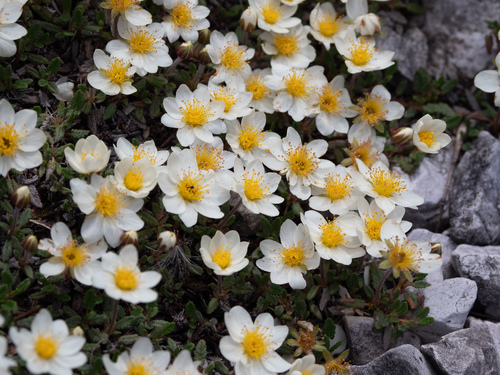
This plant is the subspecies Dryas octopetala subsp. hookeriana (Juz.) Hultén. It has woody, tortuous stems that bear short, horizontal rooting branches. Its leaves are hairless (glabrous) on the upper surface and covered in dense, white, felt-like hairs (tomentose) on the lower surface. Flowers grow on stalks measuring 3–10 cm (1–4 in) long, and each flower has eight creamy white petals – this feature gives the species its specific epithet octopetala. The style remains attached to the fruit, and has white feathery hairs that act as a wind-dispersal agent for the seeds. Before spreading out, the twisted glossy feathery hairs of the seed head loosen into an expanded ball that is quickly dispersed by wind. Dryas octopetala occurs widely across mountainous areas, where it is generally limited to limestone outcrops. Its range covers the entire Arctic, as well as the mountains of Scandinavia, Iceland, the Alps, the Carpathian Mountains, the Balkans, and the Caucasus, with additional isolated populations in other locations. In Great Britain, it grows in the Pennines of Northern England, at two sites in the Snowdonia region of North Wales, and more broadly across the Scottish Highlands. In Ireland, it is found on The Burren and a small number of other sites. In North America, it occurs in Alaska (most often on formerly glaciated terrain), extends through the Canadian Rockies, and reaches as far south as Colorado in the Rocky Mountains. It grows in dry sites where snow melts early, on gravel and rocky barrens, and forms a distinct heath community on calcareous soils. D. octopetala is cultivated in temperate regions as a groundcover, and also grown as an alpine or rock garden plant. It has been awarded the Royal Horticultural Society's Award of Garden Merit. Its leaves are sometimes used to make herbal tea.