About Dryas integrifolia Vahl
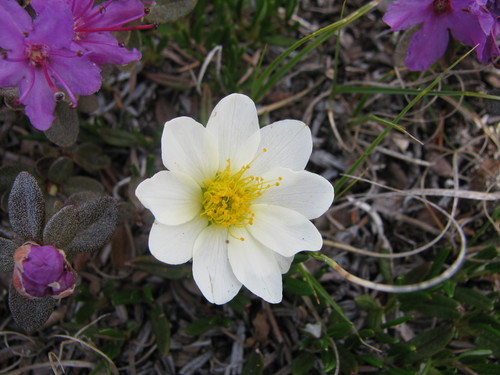
Dryas integrifolia is a flowering plant species in the rose family, with common names including arctic avens, entireleaf mountain-avens, white mountain-avens, northern white mountain avens, and mountain avens. It is native to northern North America, occurring from Alaska across Canada to Greenland. It is a common Arctic species, and is probably the most common flowering plant on some western Arctic islands. This plant is a shrub, usually a dwarf shrub. It grows as a prostrate mat reaching 10 cm (3.9 in) to 17 cm (6.7 in) in height, with stems that branch horizontally along the ground. Leaves grow on stipulate petioles covered in long, silky or woolly hairs. Leaf blades are linear to lance-shaped, and measure up to 2.2 cm (0.87 in) long. The upper surface of the blade is smooth, while the underside is densely covered in hairs. The leafless flowering stem (peduncle) is covered in long woolly hairs, and holds a single flower. The flower has up to 11 obovate petals, which are most often white, but may also be shades of yellow or cream. The center of the flower holds many stamens with yellow anthers at their tips. Styles start small and enlarge as their attached fruits mature, growing up to 2.5 cm (0.98 in) long and developing a plumelike covering of long, fluffy hairs. These plumes tangle together, and clumps of fruits break away from the plant to be carried off by wind. The fruit of this plant is an achene. Some flowers of this species show heliotropism, changing orientation to follow the sun, while others grow toward the position of the sun at noon. When a flower faces the sun, it becomes slightly warmer than surrounding surfaces, providing a resting spot for many types of insects. Additionally, atavistic character convergence has been observed in the trait expression of adjacent floral organs. For example, petals may develop the yellow marking of anthers, or a greenish midrib similar to that found on sepals. This is an actinorhizal species, meaning it can live in symbiosis with nitrogen-fixing bacteria. It can also form an ectomycorrhizal symbiosis with the mushroom Hebeloma cylindrosporum. This plant is common across many Arctic regions, growing in several types of cold, wet habitat. It can be found in tundra, meadows, river valleys, and scree slopes. It anchors well in rocky and gravelly substrates, and grows well in soils with low organic content. It is a pioneer species in rough terrain, and likely colonized large areas of the Arctic as ice sheets receded. This species dominates multiple Arctic habitat types: it is the first plant to establish in scoured substrate, and becomes the most abundant species in the area. In Montana, it dominates a dwarf heath plant community alongside sedges such as Carex rupestris. In parts of northern Alaska, it codominates bare, cryoturbated soils with the lichen Ochrolechia frigida, and codominates moist coastal flats with the sedge Carex aquatilis. The plant's ability to colonize denuded Arctic landscapes makes it useful for revegetation efforts, particularly in habitat altered by mining. Once established, its dense, matlike growth tends to accumulate organic matter. Increasing organic cover in barren mining zones is an important goal of revegetation efforts, so this species helps meet that goal. The Inuit use multiple names for this species, including malikkaat, isuqtannguat, isurramuat, and piluit, and they monitor the plant's status to track changing seasons.