About Drupella cornus (Röding, 1798)
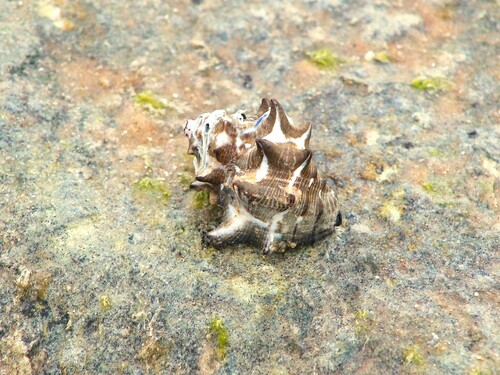
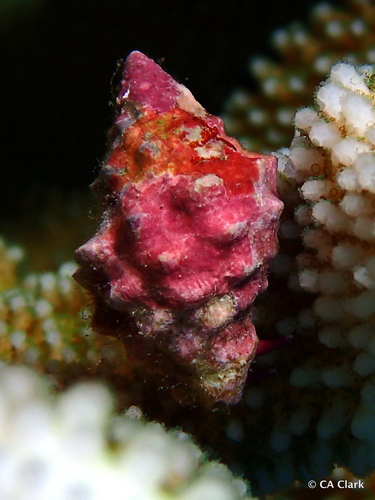
The scientific name of this species is Drupella cornus, originally described by Röding in 1798. Adult Drupella cornus have shells between 28 mm and 40 mm in size. The whitish shell has four rows of spiny, pointed nodules, with many smaller spines located between these rows. The oval aperture of the shell is yellow, and the outer lip has three to four teeth. Drupella cornus lays benthic egg capsules, which hatch into free-swimming, planktonic veliger larvae. This species is a predator of living coral, and grazes directly on coral tissue. Large populations of this snail can cause significant destruction to the hard coral cover of reefs. A possible link exists between coral disease outbreaks and population outbreaks of this snail. The snail is specifically attracted to Montipora corals when these corals secrete montiporic acids. Drupella cornus most commonly lives on or under tabular corals from the genera Acropora and Montipora, or on hard substrates in the lower intertidal zone and shallow sublittoral zone. In regions where Acropora and Montipora corals are rare, Drupella cornus has been recorded feeding on other coral genera: it feeds on Porites in Kenya, and on both Pocillopora and Porites in Hawaii. This species is distributed across the Red Sea, the Indian Ocean (including Aldabra, Chagos, Kenya, Madagascar, the Mascarene Basin, Mozambique, Tanzania, and KwaZulu-Natal), the Gulf of Thailand, Japan, and the wider Indo-Pacific.