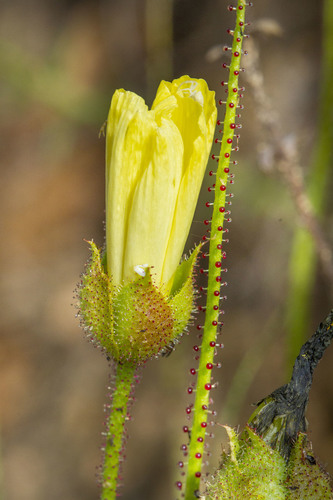
About Drosophyllum lusitanicum (L.) Link
Drosophyllum lusitanicum is a perennial carnivorous plant. It has woody stems at the base that are short, simple, or rarely branched, and can be either tortuous or erect. Leaves grow from the base in a dense rosette; these basal leaves are sessile, linear, sheathed, and circinate, and covered with both sessile and pedunculated glands. Cauline leaves are sessile and alternate, with upper leaves taking a bract-like form. Flowers grow at the top of the plant in racemiform or corymbiform arrangements, each bearing five yellow petals that measure 20–30 mm (0.79–1.18 in) long. The flower calyx has five lobes and is late-deciduous. This species has ten stamens with introrsal anthers. The gynoecium consists of five carpels, with five simple styles and capitate stigmas. The fruit is a unilocular capsule that is partially divided into five locules, and undergoes irregular dehiscence through 3-5 teeth. Seeds are pear-shaped, rough-textured, and 2.5–3.0 mm (0.098–0.118 in) in diameter. The plant's glandular leaves, which reach 10–20 cm (3.9–7.9 in) in length and uncoil from the central rosette, lack the movement ability common to most sundews. Unlike many related carnivorous plants, immature Drosophyllum lusitanicum leaves exhibit outward circinate vernation, meaning they coil outward as they develop. Scarification may help improve seed germination for this species. Drosophyllum lusitanicum is native to the western Mediterranean region, occurring naturally in Portugal, southwest Spain, and northern Morocco. It is one of the few carnivorous plant species that grows in dry soil. It grows primarily in clearings of scrub (mostly heather), pine forests, and evergreen forests such as open cork oak woodland, as well as on sunny heaths. It grows in dry locations on silicon, gravel, or shale substrates, in somewhat disturbed areas. It is a strictly calcific species, found from sea level up to 1,200 m (3,900 ft) in altitude. This plant produces a distinct sweet aroma that attracts the insects it preys on. When insects land on the leaves, they become stuck to mucilage secreted by the stalked glands covering the foliage. The more an insect struggles, the more trapped it becomes, and eventually dies from suffocation or exhaustion. The plant then secretes enzymes that dissolve the insect's body to release nutrients, which the plant then absorbs. It uses these nutrients to supplement the low nutrient content of the soil it grows in. Drosophyllum was long assumed to be closely related to Drosera, and was previously classified in the Droseraceae family. However, recent molecular and biochemical studies place it in the monotypic family Drosophyllaceae, a classification recommended by the Angiosperm Phylogeny Group. In this system, Drosophyllaceae is allied with the Dioncophyllaceae (which includes Triphyophyllum) and Ancistrocladaceae.

