About Drosophila suzukii (Matsumura, 1931)
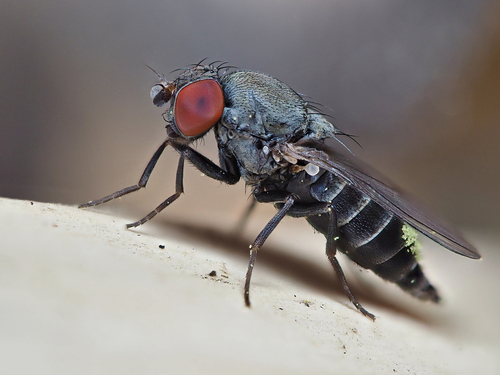
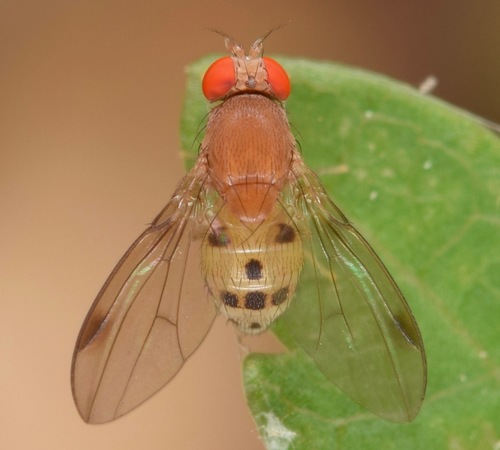
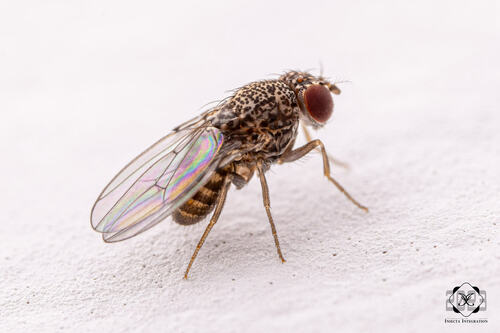
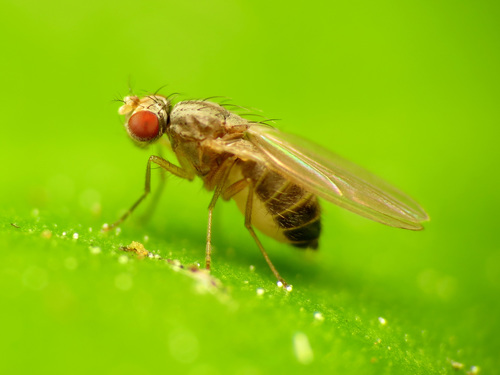
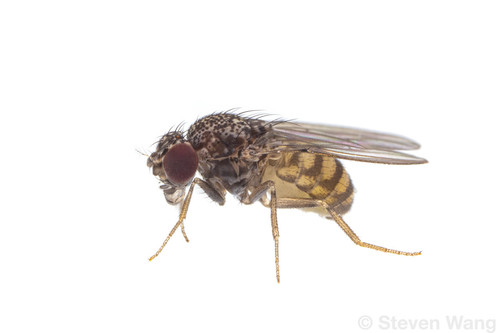
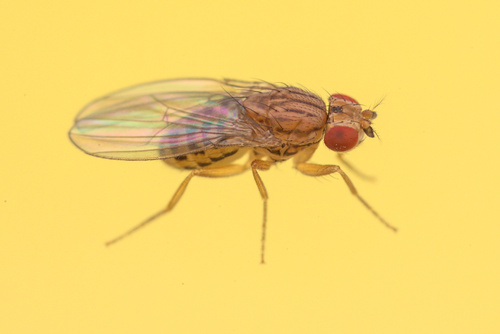
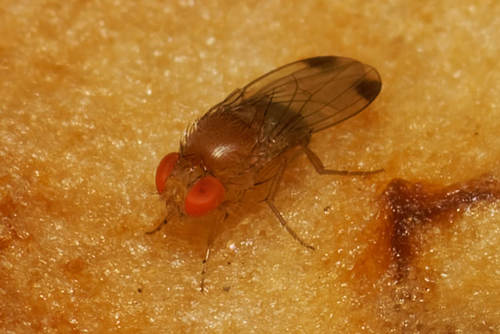
Like other members of the Drosophilidae family, Drosophila suzukii is a small fly, measuring approximately 2 to 3.5 millimetres in body length, with a 5 to 6.5 millimetre wingspan, and resembles its close relatives, other fruit and vinegar flies. Its body ranges from yellow to brown, with darker bands across the abdomen, and it has red eyes. Males have a distinct dark spot near the tip of each wing, while females do not have this spotted wing marking. Males also have dark bands on the first and second tarsi of their forelegs. Females possess a long, sharp, serrated ovipositor. The larvae are small, white, and cylindrical, and grow to a maximum length of 3.5 millimetres. When D. suzukii was first spotted in new regions, it was often confused with the western cherry fruit fly Rhagoletis indifferens, which earned it the short-lived common name cherry vinegar fly. The western cherry fruit fly is significantly larger than D. suzukii, reaching up to 5 millimetres in length, and has a pattern of dark bands across its wings rather than the single distinct spot that marks male D. suzukii. The characteristic dark spots on the wings of male D. suzukii gave the species its widespread common name "spotted wing drosophila", often abbreviated as SWD. Unlike most related vinegar flies, which are primarily attracted to rotting or fermented fruit, female D. suzukii attack fresh, ripe fruit. They use their saw-like serrated ovipositor to lay eggs under the soft skin of intact ripe fruit. After hatching, larvae develop and feed inside the fruit, destroying its commercial value. This species causes major economic harm; large-scale infestations that cause a 20% loss across the United States alone could result in farm gate economic impacts exceeding $500 million. D. suzukii has a slower rate of evolution than related species, because it enters winter diapause which reduces the number of generations it produces per year. D. suzukii is native to southeast Asia, and was first formally described in 1931 by Matsumura. It was observed in Japan as early as 1916 by T. Kanzawa, and was widely recorded across parts of Japan, Korea, and China by the early 1930s. By the 1980s, the spotted wing fruit fly had been observed in Hawaii. It first reached mainland North America in central California in August 2008, and was found in the Pacific Northwest (Oregon and Washington State) in 2009, as documented by Lee et al. in 2011. Today it is widespread across California's coastal counties, western Oregon, western Washington, parts of British Columbia, and parts of Florida. During summer 2010, the fly was discovered for the first time in South Carolina, North Carolina, Louisiana, and Utah. In fall 2010, it was also found in Michigan and Wisconsin. The fly was first recorded in the northeastern United States in 2011, and in Minnesota and Idaho in 2012. As D. suzukii continues to spread, it is expected that it will eventually become established in most US states and Canadian provinces. This pest has also been found in Europe, including in Belgium, Italy, France, the Netherlands, and Spain.