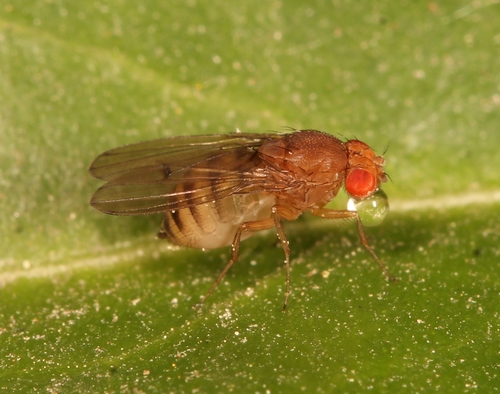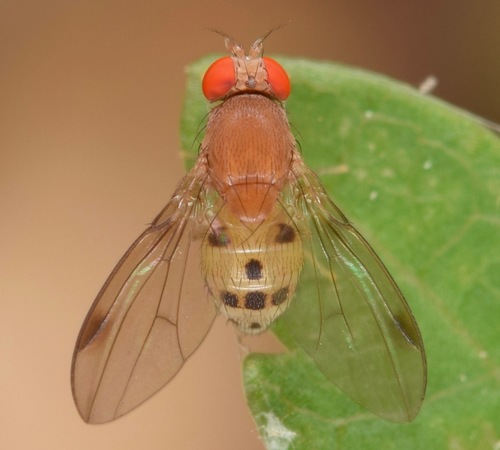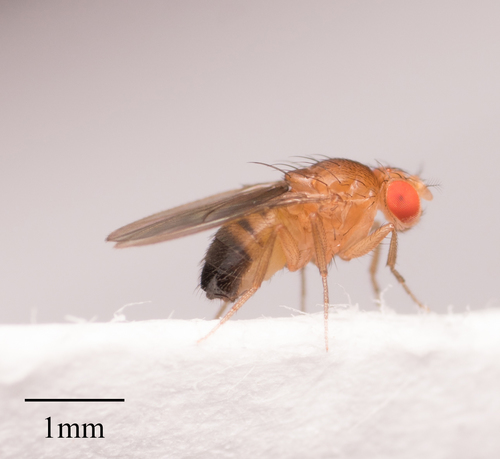
About Drosophila melanogaster Meigen, 1830
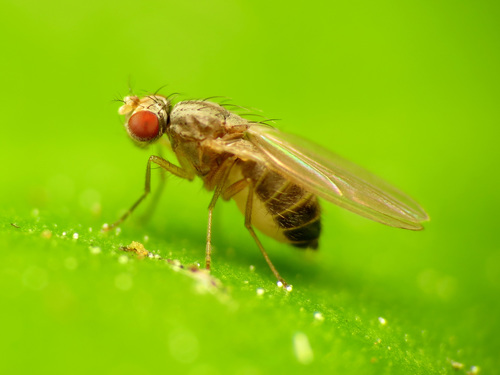
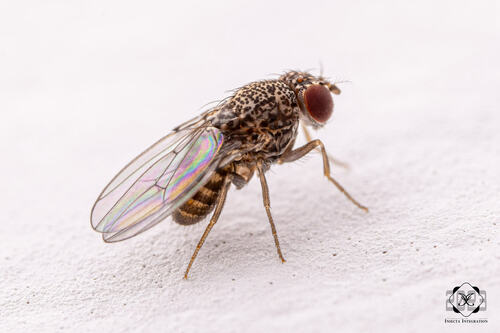
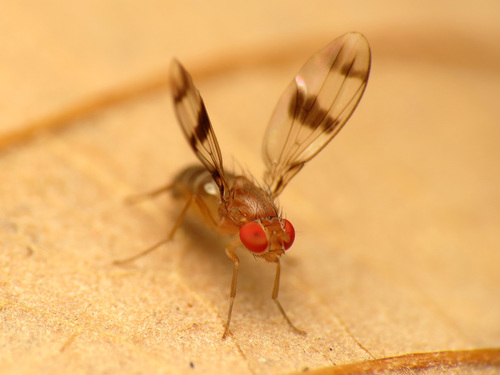
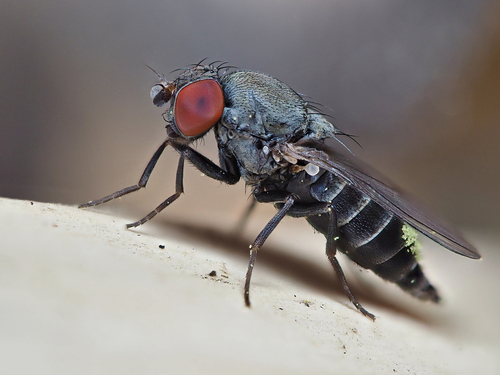
Drosophila melanogaster Meigen, 1830 is a species of fly, an insect in the order Diptera, family Drosophilidae. It is most commonly known as the fruit fly or lesser fruit fly, and less often called the vinegar fly, pomace fly, or banana fly. In the wild, this species is attracted to rotting fruit and fermenting beverages, and is frequently found in orchards, kitchens, and pubs. Starting with Charles W. Woodworth's 1901 proposal that this species be used as a model organism, D. melanogaster has remained widely used for biological research into genetics, physiology, microbial pathogenesis, and life history evolution. In 1946, D. melanogaster became the first animal launched into space. As of 2017, six Nobel Prizes have been awarded to researchers working with this insect. It is commonly used in research because of its rapid life cycle, relatively simple genetics with only four pairs of chromosomes, and large number of offspring produced per generation. It was originally an African species, and all non-African lineages share a common origin. Its current geographic range covers all continents, including islands. D. melanogaster is a common pest in homes, restaurants, and other food service locations. Flies from the family Tephritidae are also called fruit flies, which can cause confusion, particularly in the Mediterranean, Australia, and South Africa, where the Mediterranean fruit fly Ceratitis capitata is an economically important pest. Under optimal growth conditions at 25 °C (77 °F), the total lifespan of D. melanogaster from egg to death is about 50 days. Like most ectothermic species, D. melanogaster's developmental period changes with temperature. The shortest development time from egg to adult, seven days, occurs at 28 °C (82 °F). Development time increases at higher temperatures, reaching 11 days at 30 °C (86 °F), due to heat stress. Under ideal conditions, development takes 8 and 1/2 days at 25 °C (77 °F), 19 days at 18 °C (64 °F), and over 50 days at 12 °C (54 °F). When living in crowded conditions, development time increases, and newly emerged adult flies are smaller in size. Female D. melanogaster lay around 400 eggs, or embryos, in batches of roughly five at a time, depositing them into rotting fruit or other suitable materials such as decaying mushrooms and sap fluxes. D. melanogaster is a holometabolous insect, meaning it undergoes full metamorphosis. Its life cycle is divided into four stages: embryo, larva, pupa, and adult. The eggs, which measure around 0.5 mm long, hatch after 12 to 15 hours when kept at 25 °C (77 °F). The resulting larvae grow for roughly four days at 25 °C, molting twice into second-instar and third-instar larvae at about 24 and 48 hours after hatching. During this growth period, larvae feed on the microorganisms that decompose the fruit they develop in, as well as the sugar from the fruit itself. Mothers deposit feces on their egg sacs to establish the same beneficial microbial composition in their larvae's guts that worked for them. Before entering metamorphosis, larvae expel a transparent glue from their salivary glands through their mouth; this glue solidifies within a few seconds to anchor the larva to a substrate. Larvae then encapsulate inside the puparium and undergo a four-day-long metamorphosis at 25 °C, after which adult flies eclose, or emerge. Males follow a sequence of five behavioral patterns to court females. First, males orient themselves toward females while producing a courtship song by horizontally extending and vibrating their wings. Soon after, the male positions himself at the rear of the female's abdomen in a low posture to tap and lick the female's genitalia. Finally, the male curls his abdomen and attempts copulation. Females can reject males by moving away, kicking, and extruding their ovipositor. Copulation lasts around 15 to 20 minutes, during which males transfer a few hundred very long 1.76 mm sperm cells in seminal fluid to the female. Females store sperm in a tubular receptacle and in two mushroom-shaped spermathecae, and sperm from multiple matings compete to fertilize eggs. A pattern called last male precedence is thought to exist: the last male to mate with a female sires approximately 80% of her offspring. This precedence occurs through two mechanisms: sperm displacement and sperm incapacitation. Displacement occurs as the female handles sperm during multiple matings, and is most significant during the first 1 to 2 days after copulation. Displacement from the seminal receptacle is more significant than displacement from the spermathecae. Incapacitation of a first male's sperm by a second male's sperm becomes significant 2 to 7 days after copulation. The seminal fluid of the second male is believed to cause this incapacitation, which works without removing the first male's sperm and takes effect before fertilization occurs. The delayed effectiveness of this incapacitation mechanism is thought to act as a protection, preventing a male from incapacitating his own sperm if he mates repeatedly with the same female. Sensory neurons in the uterus of female D. melanogaster respond to a male protein called sex peptide, which is found in semen. This protein makes females unwilling to copulate for roughly 10 days after insemination. The signal pathway leading to this behavioral change has been fully mapped: the signal is sent to a brain region that is a homolog of the hypothalamus, and the hypothalamus then controls sexual behavior and mating desire. Gonadotropic hormones in Drosophila maintain homeostasis and control reproductive output through a cyclic interrelationship, similar to the mammalian estrous cycle. Sex peptide disrupts this homeostasis and drastically changes the female's endocrine state by triggering juvenile hormone synthesis in the corpus allatum. D. melanogaster is often used for life extension and aging studies, such as to identify genes that are claimed to increase lifespan when mutated. Werner syndrome is a human condition characterized by accelerated aging, caused by mutations in the WRN gene that encodes a protein essential for DNA damage repair. Mutations in the D. melanogaster homolog of the WRN gene also cause increased physiological signs of aging, including shorter lifespan, higher tumor incidence, muscle degeneration, reduced climbing ability, altered behavior, and reduced locomotor activity. D. melanogaster was among the first organisms used for genetic analysis, and today it is one of the most widely used and genetically best-studied of all eukaryotic organisms. All organisms share common genetic systems, so understanding processes like transcription and replication in fruit flies helps researchers understand these same processes in other eukaryotes, including humans. Thomas Hunt Morgan began using fruit flies for experimental heredity studies at Columbia University in 1910, in a laboratory nicknamed the Fly Room. The Fly Room was a cramped space with eight desks, each used by a student and their experiments. Early experiments used milk bottles to rear fruit flies and handheld lenses to observe their traits. Lenses were later replaced by microscopes, which improved observation quality. Morgan and his students eventually described many basic principles of heredity, including sex-linked inheritance, epistasis, multiple alleles, and gene mapping. Historically, D. melanogaster was used in laboratories to study genetics and inheritance patterns, but it is also important for environmental mutagenesis research, letting researchers study the effects of specific environmental mutagens. There are many reasons this fruit fly is a popular model organism for laboratory research. Approximately 75% of human disease-causing genes have a functional equivalent in the fruit fly genome. Its care and culture requires little equipment, space, and expense even when working with large cultures. It can be safely and easily anesthetized, usually with ether, carbon dioxide gas, cooling, or products like FlyNap. Fly morphology is easy to identify after anesthetization. It has a short generation time of around 10 days at room temperature, so multiple generations can be studied within just a few weeks. It has high fecundity: females can lay up to 100 eggs per day, and as many as 2,000 eggs over a lifetime. Males and females are easily distinguished, and virgin females can be readily identified by their light-colored, translucent abdomen, making genetic crossing simple. Mature larvae have giant chromosomes in their salivary glands called polytene chromosomes; regions called "puffs" on these chromosomes indicate active transcription, and thus active gene activity. In D. melanogaster polytene chromosomes, under-replication of rDNA occurs, resulting in only 20% of the DNA content found in brain tissue, compared to 47% rDNA under-reduction in Sarcophaga barbata ovaries. This species only has four pairs of chromosomes: three pairs of autosomes, and one pair of sex chromosomes. Males do not undergo meiotic recombination, which simplifies genetic studies. Recessive lethal balancer chromosomes that carry visible genetic markers can be used to maintain stocks of lethal alleles in a heterozygous state, with no recombination occurring due to multiple inversions in the balancer chromosome. The full development of this organism from fertilized egg to mature adult is well characterized. Genetic transformation techniques have been available for D. melanogaster since 1987. One common method for inserting foreign genes into the Drosophila genome uses P elements, which are transposable DNA segments originally from bacteria that can be transferred into the fly genome to create transgenic lines. Transgenic flies have already contributed to many scientific advances, including the creation of models for human diseases such as Parkinson's, neoplasia, obesity, and diabetes. Thousands of genetic strains, optimized for a wide range of research purposes, are readily available from stock centers such as the Bloomington Drosophila Stock Center. D. melanogaster's complete genome was sequenced and first published in 2000. Its connectome, a full map of the fly's neurons and their interconnections, is available for larvae, and for both male and female adult flies. Sexual mosaics can be easily produced, providing an additional tool for studying the development and behavior of this species.