About Drosera rotundifolia L.
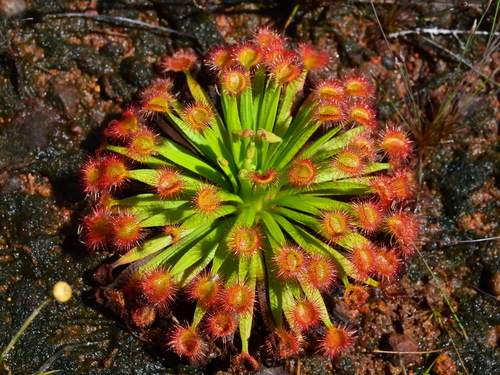
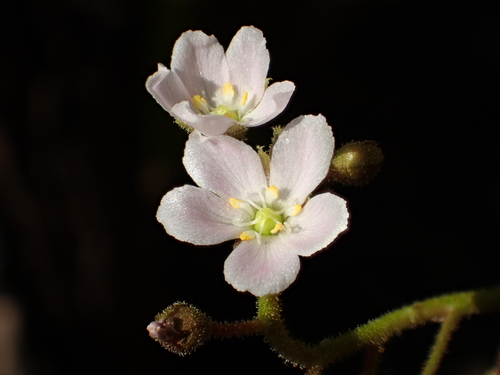
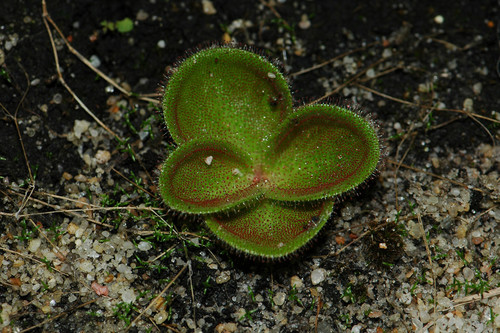
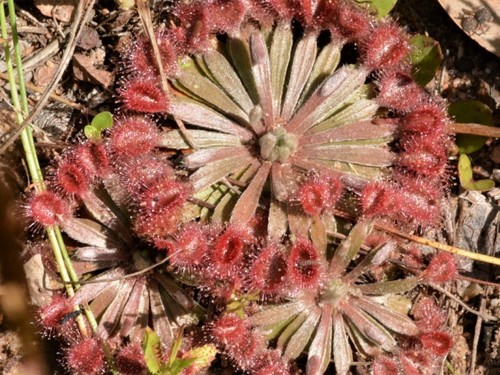
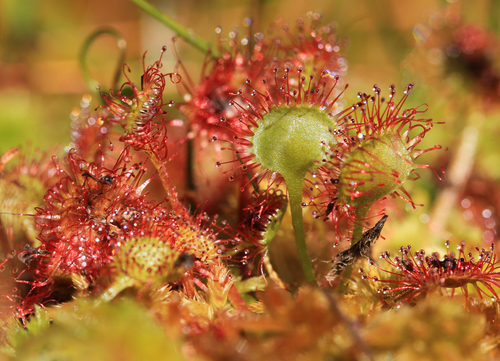
Drosera rotundifolia L., commonly known as common sundew or roundleaf sundew, has leaves arranged in a basal rosette. Its narrow, hairy petioles measure 1.3 to 5.0 centimetres (0.5 to 2.0 in) long, and support round laminae that are 4 to 10 millimetres (0.2 to 0.4 in) across. The upper surface of the lamina is densely covered with red glandular hairs that secrete a sticky mucilage. A mature common sundew typically reaches 3 to 5 centimetres (1.2 to 2.0 in) in diameter, and produces a 5 to 25 centimetre (2 to 10 in) tall inflorescence. Flowers grow along one side of a single slender, hairless stalk that emerges from the center of the leaf rosette. These five-petalled flowers are white or pink, and produce light brown, slender, tapered seeds that measure 1.0 to 1.5 millimetres (0.04 to 0.06 in) long. To survive cold winter conditions, D. rotundifolia forms a hibernaculum: a bud of tightly curled leaves held at ground level. In North America, common sundew occurs across most of Canada except the Canadian Prairies and tundra regions, plus southern Alaska, the Pacific Northwest, and along the Appalachian Mountains south to Georgia and Louisiana. In the western United States, it grows in mountain fens as far south as California's Sierra Nevada, and in an isolated cluster of fen populations in the Rocky Mountains of Colorado. In the eastern United States, it occurs in a range extending from Nova Scotia down the Atlantic coast into Georgia; established populations have also been documented in Alabama and Mississippi. West of the Mississippi River, it grows along the Pacific coast from Alaska south to California, with new records of populations from Iowa, Minnesota, Gunnison County Colorado, and Bottineau County North Dakota. It is widespread across much of Europe: it occurs in the British Isles, most of France, the Benelux countries, Germany, Denmark, Switzerland, the Czech Republic, Poland, Belarus, the Baltic countries, Sweden, Finland, northern portions of Italy, Portugal, Spain, Romania, mountain regions of Bulgaria, Iceland, southern Norway, and southern Greenland. It is uncommon in Austria and Hungary, with scattered isolated populations across the Balkans. In Britain, it is the most common sundew species, widespread across the west and north, including Exmoor, Dartmoor, Sedgemoor, the Lake District, Shropshire, the Pennines, and all of Scotland; it is rare and scattered in the Midlands and eastern England. It is the county flower of Shropshire, and is also common in Ireland. It usually grows in bogs, marshes, and hollows or corries on mountain slopes. In Asia, it is found across Siberia and Japan, as well as parts of Turkey, the Caucasus region, the Kamchatka Peninsula, southern Korea, and northeastern and eastern China. Small populations also exist on the islands of New Guinea and Mindanao. Common sundew grows best in wetland habitats including marshes and fens. It can also be found in wet stands of black spruce, Sphagnum bogs, silty and boggy shorelines, and wet sands. It prefers open, sunny or partly sunny sites. Drosera rotundifolia is one of the temperate Drosera species cultivated by carnivorous plant enthusiasts. Wild-type plants require a long winter dormancy period, during which they form hibernacula, to grow successfully. The cultivar D. rotundifolia 'Charles Darwin' can be grown successfully without a cold dormancy period. According to research by D.H. Paper et al., extracts of Drosera rotundifolia show greater efficacy as an anti-inflammatory and antispasmodic than extracts of D. madagascariensis. This effect comes from flavonoids found in the extracts, including hyperoside, quercetin, and isoquercetin, and not from the naphthoquinones also present in the plant. It is thought that these flavonoids interact with M3 muscarinic receptors in smooth muscle to produce the observed antispasmodic effects. Ellagic acid found in D. rotundifolia extracts has also been shown to have antiangiogenic effects.