About Drosera L.
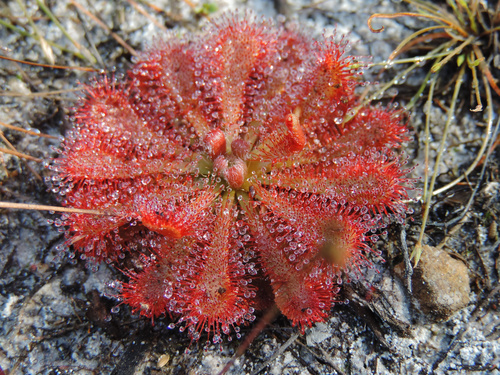
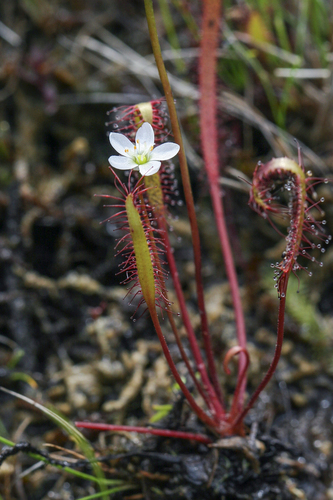
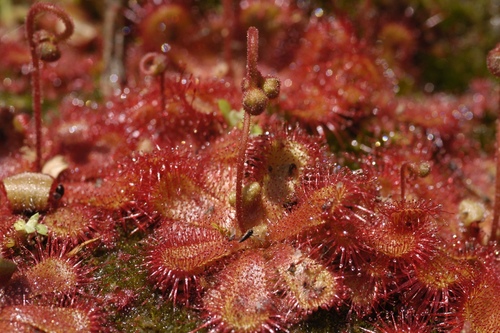
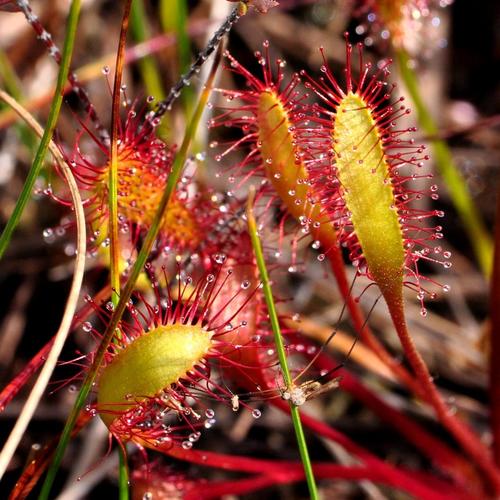
Drosera anglica, commonly called the English sundew, is a perennial carnivorous herb that grows as an upright, stemless rosette of generally linear-spatulate leaves. Like all sundews, its leaf blades are densely covered with stalked reddish mucilaginous glands, each tipped with a clear droplet of viscous fluid used to trap insects. The leaf blade itself measures 15–35 mm (0.59–1.38 in) long, and is held semi-erect by a long petiole, bringing the total leaf length to 30–95 mm (1.2–3.7 in). Plants are green when grown in lower light, and turn red when exposed to bright light. All populations except those found on Kauaʻi form winter resting buds called hibernacula: these are a knot of tightly curled leaves positioned at ground level that unfurl in spring after dormancy ends. This species has a weak root system that only penetrates a few centimeters into the ground, and roots mainly act as an anchor while also absorbing water. Bogs typically have very low available nitrogen, so trapping and digesting insects gives D. anglica an alternate source of this nutrient.
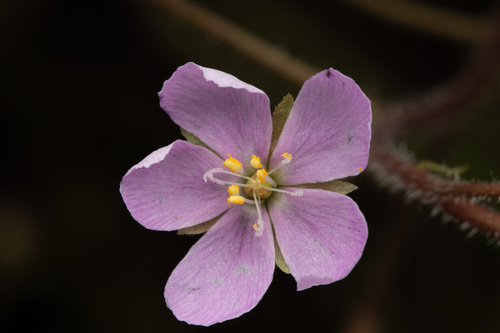
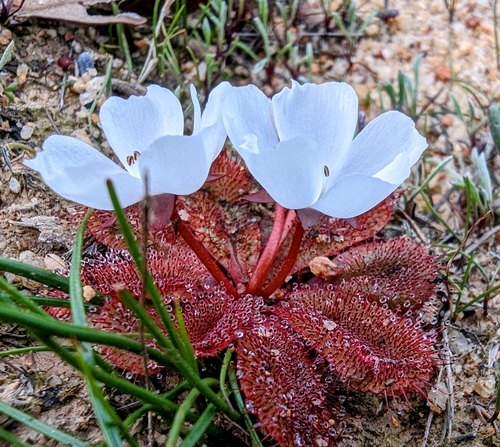
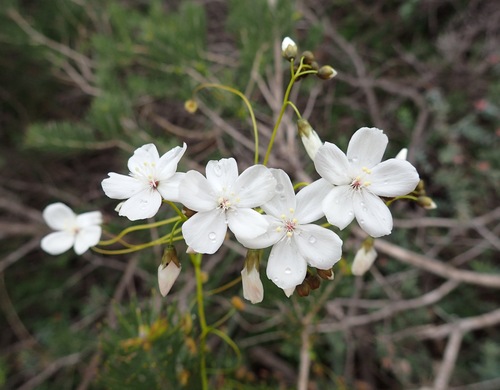
Drosera anglica flowers in summer, growing 6–18 cm (2.4–7.1 in) long peduncles that hold several white flowers that open one at a time. Like other sundews, its flowers have five sepals, five petals, five stamens, and three styles. For this species, petals measure 8–12 mm (¼ to ½ inch) long, and flowers have branched 2-lobed styles. The flowers have no odor and produce no nectar, and do not rely on insect pollinators. Instead, they successfully set seed through autogamy, or self-pollination. Seeds are black, roundish spindle-shaped, and 1 to 1+1⁄2 mm long. Fruits are dehiscent three-valved capsules.
This species grows in open, non-forested habitats with wet, often calcium-rich soils. Common habitats include bogs, marl fens, quaking bogs, cobble shores, and other calcareous sites. This ability to tolerate calcium is relatively uncommon among other species in the Drosera genus. Drosera anglica is often associated with various sphagnum mosses, and frequently grows in a substrate made entirely of living, dead, or decomposed sphagnum. Sphagnum draws moisture to the soil surface while also acidifying the soil. Any soil nutrients not washed away by constant moisture are either taken up by sphagnum or made unavailable by the low soil pH. Low nutrient availability reduces competition from other plants, allowing this carnivorous sundew to grow well.
Drosera anglica is one of the most widely distributed sundew species in the world, with a generally circumboreal range found at high latitudes across the globe. It also occurs farther south in a few locations, specifically Japan, southern Europe, the Hawaiian island of Kauaʻi, and California. On Hawaii, this species is called mikinalo; plants from this population are generally smaller than average and do not go through winter dormancy. It occurs naturally in 12 U.S. states including Alaska, and 11 Canadian provinces and territories. Its altitudinal range spans from 5 meters (16 feet) to at least 2,000 meters (6,600 feet). In the U.S. state of Minnesota, it was first recorded in 1978 growing in shallow pools in peatlands with minerotrophic water, where the plant community was dominated by low-growing mosses and sedges. Due to its limited, small populations and the specialized microhabitat it occupies, it is listed as a threatened species in Minnesota.