About Drosera filiformis var. tracyi (Macf. ex Diels) Diels
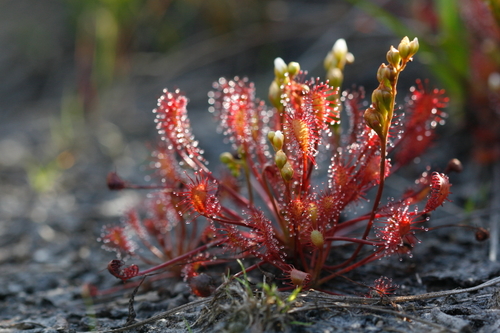
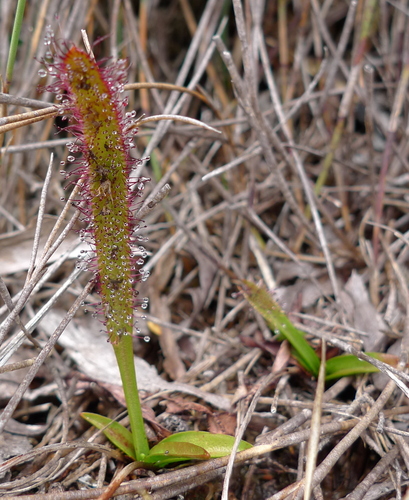
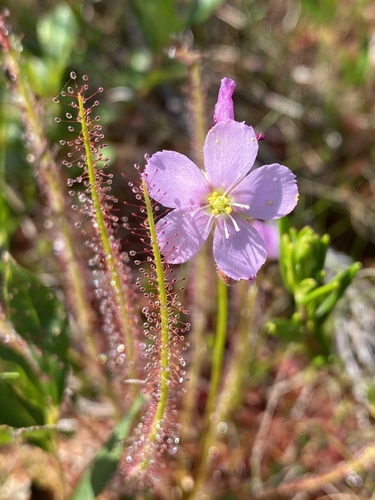
Drosera filiformis, commonly known as Tracy's sundew, dewthread, or the thread-leaved sundew, is a small, insectivorous, rosette-forming perennial herb species. As a member of the sundew genus, it has an unusual trait for the group: its long, erect, thread-like (filiform) leaves unroll in spirals, an arrangement similar to the circinate vernation found in ferns.
Drosera filiformis grows naturally in both Canada and the United States. Its native range follows the eastern seaboard of North America, stretching from southwestern Nova Scotia in the north, through New England, down to Florida in the south. This species has a disjunct distribution along the Atlantic Coast, which reflects the prehistoric land connection between Nova Scotia and Cape Cod, Massachusetts. This connection formed an ancient extension of the Atlantic Plain region that likely remained as an island chain well into the current interglacial period. Drosera filiformis also grows on the Gulf Coast from Florida to Louisiana, though these Gulf Coast populations may actually belong to the separate species Drosera tracyi.
Drosera filiformis is frequently cultivated, and a small number of registered cultivars exist. These include Drosera filiformis var. filiformis (also called D. filiformis typical), and Drosera filiformis × 'California Sunset', a hybrid of D. filiformis var. filiformis. All of these cultivars are grown under the same general conditions as most other Drosera species, requiring mineral-poor soil and water from distilled, reverse osmosis, or collected rain sources. For long-term survival, D. filiformis needs a winter dormancy, and forms winter resting structures called hibernacula during this period.