About Drosera capillaris Poir.
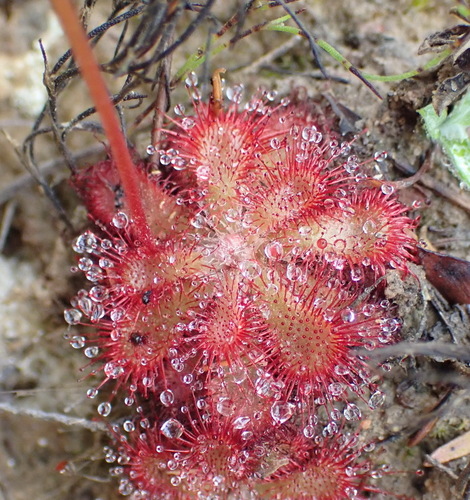
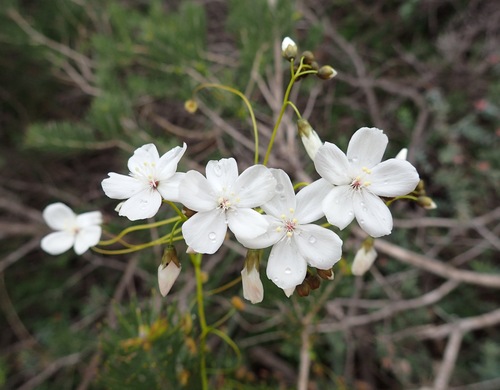
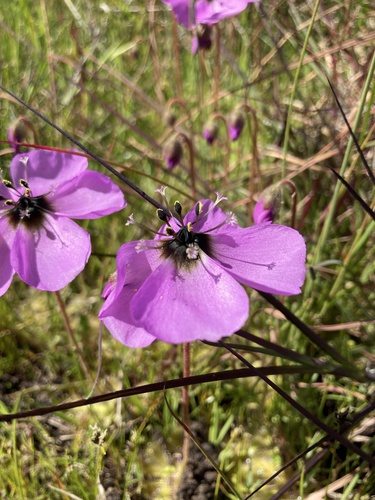
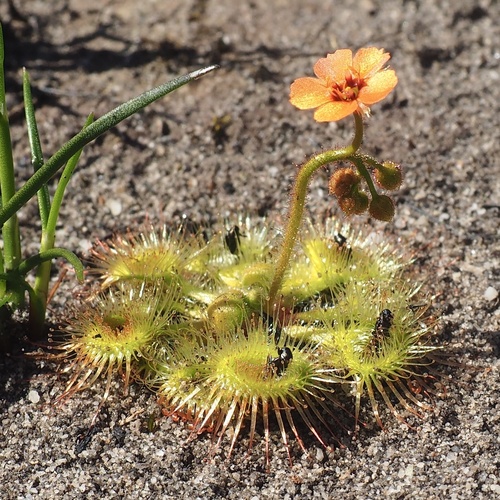
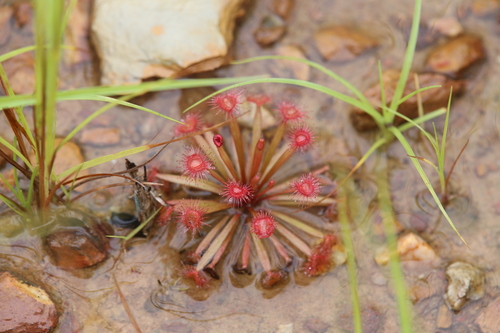
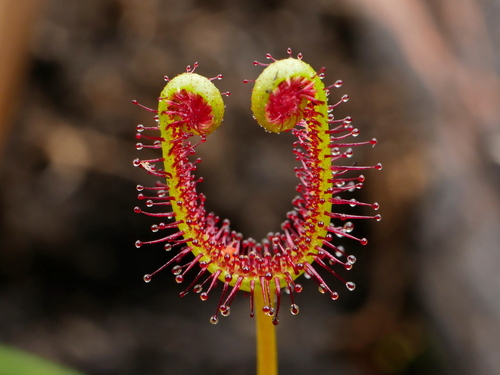
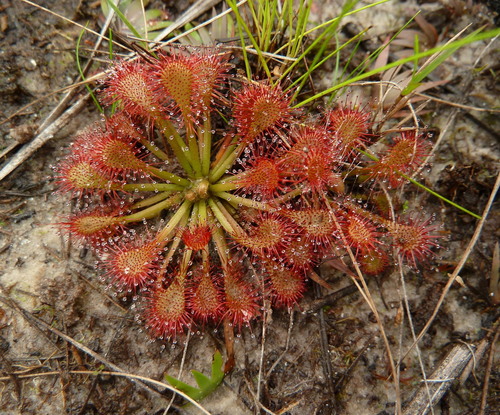
Drosera capillaris Poir. is a perennial herbaceous carnivorous plant that forms mostly prostrate rosettes, though its rosettes may occasionally grow upright. In more temperate regions, it grows as an annual. At full size, its rosettes can reach 3 inches (7.6 cm) in diameter. Individual leaf blades typically range from 0.5 inches (1.3 cm) to 1 inch (2.5 cm) long. Its inflorescences grow 4 inches (10 cm) to 14 inches (36 cm) tall, forming a one-sided raceme that holds 1 to 6 pink blooms, which are rarely white. After flowering, blooms develop into an ovoid capsule roughly 1⁄8 inch (0.32 cm) long. This species typically flowers from May to August. D. capillaris is easily confused with Drosera intermedia, or spoonleaf sundew, especially when young, because both form flat rosettes and grow in the same habitats. D. capillaris can be distinguished by its sparsely pilose petioles, while D. intermedia has glabrous petioles. Like all species in the Drosera genus, D. capillaris leaf blades are covered in glandular trichomes that excrete sugary mucilage. Small invertebrates become trapped in these mucilage-covered hairs, and are then digested by enzymes produced by the plant. The trichomes function similarly to tentacles, curling around trapped prey to further secure them. Drosera capillaris grows naturally in subtropical to tropical seepage bogs, savannas, and grasslands, which are often dominated by pine species including Pinus palustris (longleaf pine), P. elliottii (slash pine), and P. caribaea (Caribbean pine). These habitats experience frequent fires, though fires occur less often here than in the related upland habitats that typically burn seasonally. Like other sundew species, D. capillaris is adapted to fire: removing competing plants allows D. capillaris seedlings to multiply, and reduced competition lets this species and other carnivorous plants reestablish in the local area. Thick clay deposits in these habitats prevent large trees and shrubs from establishing, and also trap water. This creates consistently wet, sunny habitats that are highly acidic, sandy, and low in nutrients. Nutrient deficiency is what drives the evolution of carnivory in this group of plants. D. capillaris thrives in these low-nutrient environments because it obtains most of its required nutrients from the prey it captures. The harsh conditions of its typical habitat have also led to the evolution of roots adapted to low-nutrient conditions, which also anchor the plant in the ground. In North America, D. capillaris grows alongside other unrelated carnivorous plant species including Sarracenia (pitcher plants), Pinguicula (butterworts), Utricularia (bladderworts), and other Drosera species. Across its entire range, other common species that coexist with D. capillaris include orchids, Eleocharis (spikerushes), Rhynchospora (breaksedges), and Paspalum.