About Drosera binata Labill.
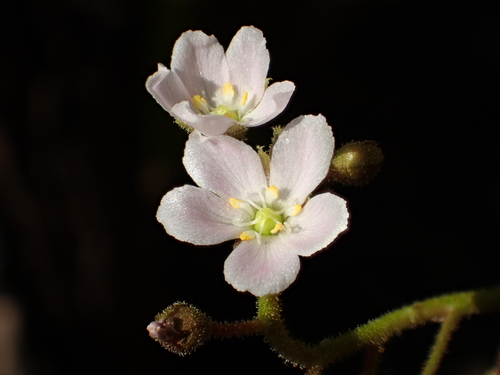
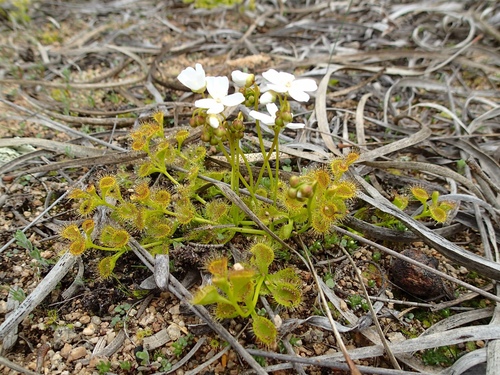
Drosera binata Labill., commonly called the forked sundew or fork-leaved sundew, is a large perennial carnivorous sundew native to southeastern Australia and New Zealand. Its specific epithet is Latin for "having pairs", referring to its dichotomously divided or forked leaves, which are sometimes twice-dichotomously divided. These leaves can grow up to 60 cm (24 in) long. Like all sundews, this species is carnivorous. It is unique among sundews for its narrow, branching leaves, and it is the only species classified in the Drosera section Phycopsis. In Australia, D. binata occurs naturally primarily in coastal areas, ranging from Fraser Island in Queensland south through New South Wales and Victoria to Tasmania and the southeastern corner of South Australia. Its native range extends to New Zealand, where it is common at elevations below 1,000 metres. It can be found across both the North and South Islands, Stewart Island / Rakiura, and the more distant Chatham Islands. Some D. binata populations become dormant in winter, while others are truly tropical.