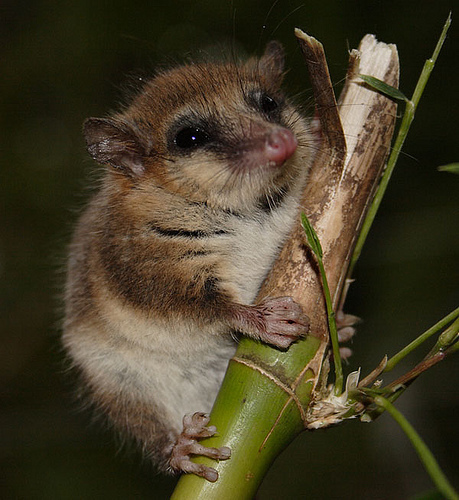
About Dromiciops gliroides Thomas, 1894
Monitos del monte (Dromiciops gliroides) are small mouse-like marsupials. They share the same dental formula as didelphids: 5.1.3.4 / 4.1.3.4, giving them a total of 50 teeth. Adult individuals weigh between 16 and 42 g (0.56–1.48 oz). They have short, dense fur that is primarily brown-gray, with white patches on the shoulders and back, and a cream or light gray underside. They have distinct black rings encircling their eyes. Their small, furred ears are well-rounded, and their rostrums are short. Head-to-body length ranges from 8–13 cm (3.1–5.1 in), while tail length is 9–13 cm (3.5–5.1 in). Their tails are somewhat prehensile and mostly furred, except for a 25–30 mm (0.98–1.18 in) section on the underside. The naked section of the tail underside may help increase friction when the animal climbs on trees. The base of the tail also acts as a fat storage organ used during winter hibernation; monitos del monte can store enough fat in a week to double their body size.
This species inhabits dense highland forests of Argentina and Chile, spending most of its time in trees. Individuals build spherical nests from water-resistant colihue leaves, line the nests with moss or grass, and place them in well-protected tree locations such as underbrush, tree cavities, or under fallen timber. Nests are sometimes covered with gray moss for camouflage. These nests help protect monitos del monte from cold both during activity and hibernation. Fragmentation of Valdivian temperate rainforests into non-contiguous patches reduces the local abundance of monitos del monte, but has little to no effect on whether the species is present in an area at all.
Monitos del monte have a monogamous mating system. Females have a well-formed, fur-lined pouch that holds four teats. They typically breed once a year in spring, and produce litters of between one and five offspring. They can only support a maximum of four young at a time, so one young will not survive when a litter of five is born. When offspring reach an age of around five months, they are old enough to leave the pouch. After leaving the pouch, they are nursed in a distinctive nest, then carried on their mother’s back. Young continue to associate with their mother after weaning. Both male and female monitos del monte reach sexual maturity at two years of age.

