About Dromia personata (Linnaeus, 1758)
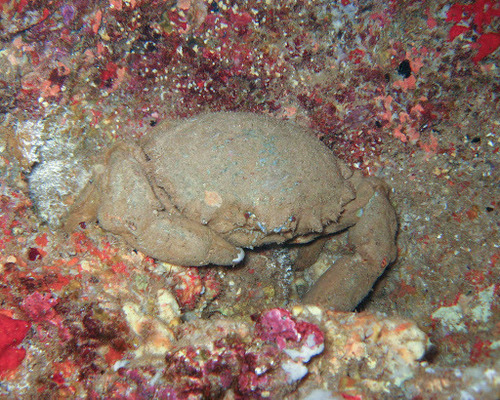
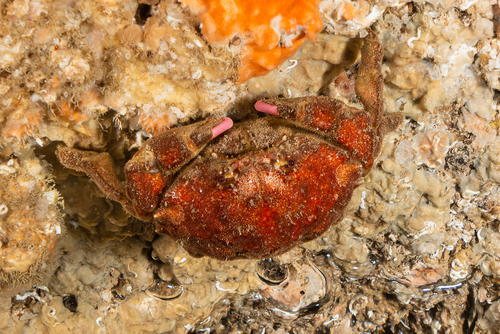
As an arthropod, Dromia personata is bilaterally symmetrical. Its body is made up of a head that contains the cephalon, and an elongated trunk formed by the thorax and abdomen. On the anterior part of the cephalon, there are two pairs of antennae and one mandible, with two pairs of maxillae positioned laterally. The trunk bears five pairs of walking legs, which are segmented from medial to lateral as: coxa, basis, ischium, merus, carpus, manus, and dactyl. The coxa, basis, and ischium are smaller segments that function to attach the jointed limb to the crab's body. D. personata has an exoskeleton made of a chitin cuticle, which is shed periodically during the crab's process of ecdysis. After this shedding, the crab itself or other organisms will eat the old exoskeleton to obtain its nutrients. Most of D. personata's body is covered in tiny dark brown hairs that give it a smooth or velvet-like appearance. The only exception is the tips of its chelipeds, which are typically white or light pink, and hairless. These two chelipeds are large, equal in size and shape, and positioned ventrally. Most crabs use eight pereiopods (the second through fifth pairs of legs) for swimming, but D. personata only uses its second and third pairs of legs for locomotion; these legs are long and stout. It uses its remaining ambulatory legs (the fourth and fifth pairs) to hold sponges against the hairs of its dorsal cephalothorax. These legs are short, narrow, flat, and positioned dorsally. Dromia personata is a gonochoric (separate-sex) species. Courtship before copulation is most commonly carried out through visual, olfactory, or tactile cues. Sperm can only be transferred directly from the male's gonopod into the ovigerous female after she has molted, when her new exoskeleton has not yet hardened. Females store eggs on a pleopod, and can also store sperm for up to nine months. During development, the blastula forms three tissue layers: the ectoderm, mesoderm, and endoderm. The mesoderm tissue produces the coelom, which develops into the body cavity and specialized tissues and organs. Fertilized eggs hatch into larvae, which go through four zoeal stages, followed by a megalopal stage, and finally reach the adult stage. With each molt between these developmental phases, the crab grows new appendages, and already established limbs become more specialized.