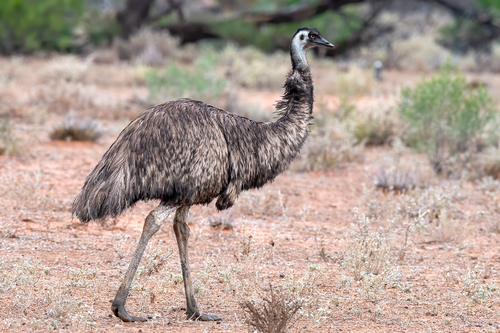
About Dromaius novaehollandiae (Latham, 1790)
The emu, scientifically named Dromaius novaehollandiae, is the second tallest living bird in the world, with only the ostrich growing taller. The largest emus reach a height of 150 to 190 cm (59 to 75 in). Measured from the bill to the tail, emus range from 139 to 164 cm (55 to 65 in) long; males average 148.5 cm (58.5 in) long, while females average 156.8 cm (61.7 in). Emus rank as the fourth or fifth heaviest living bird, following the two ostrich species and two larger cassowary species, and weigh slightly more on average than the emperor penguin. Adult emus weigh between 18 and 60 kg (40 and 132 lb), with an average weight of 31.5 kg (69 lb) for males and 37 kg (82 lb) for females. Females are usually slightly larger than males, with a noticeably wider rump. Though emus are flightless, they have small vestigial wings with a wing chord measuring around 20 cm (8 in), and each wing ends in a small claw. Emus flap their wings while running, which likely helps stabilize them when moving at high speeds. They have long necks and legs, and their highly specialized pelvic limb musculature allows them to run at speeds up to 48 km/h (30 mph). Their feet have only three toes, plus a reduced number of bones and associated foot muscles. Emus are unique among birds for having four bellies in their gastrocnemius muscles (located at the back of the lower legs), instead of the typical three. The total proportion of an emu’s body mass made up by its pelvic limb muscles is similar to the proportion of body mass that flight muscles make up in flying birds. When walking, an emu’s stride is about 100 cm (3.3 ft), but a full gallop can produce strides as long as 275 cm (9 ft). Emu legs have no feathers, and thick cushioned pads lie underneath their feet. Like cassowaries, emus have sharp claws on their toes, which are their main defensive adaptation; they use these claws to inflict wounds on opponents when kicking. The combined length of the toe and claw is 15 cm (6 in). The emu’s bill is relatively small, measuring 5.6 to 6.7 cm (2.2 to 2.6 in), and it is soft, adapted for grazing. Emus have good eyesight and hearing, which lets them detect threats from a distance. An emu’s neck is pale blue, and the color shows through its sparse covering of feathers. Emu plumage is shaggy and grey-brown, with black feather shafts and tips. The black tips absorb solar radiation, while the inner plumage insulates the skin. This adaptation stops emus from overheating, letting them stay active during the hot daytime. A unique feature of the emu feather is that two rachises emerge from a single shaft. Both rachises are the same length, and their texture varies: the area near the skin is quite furry, while the outer ends resemble grass. Males and females look very similar, though a male’s penis may become visible when he urinates and defecates. Emu plumage color varies due to environmental factors, providing natural camouflage. Emus living in more arid areas with red soils have a reddish rufous tint to their feathers, while emus in damp environments are generally darker. Juvenile emus develop their first plumage at around three months old: it is blackish with fine brown barring, and the head and neck are especially dark. Facial feathers gradually thin out to reveal the underlying bluish skin. Adult plumage is fully developed by around fifteen months of age. Emu eyes are protected by nictitating membranes, which are translucent secondary eyelids that move horizontally from the inner edge of the eye to the outer edge. They act as visors to shield the eyes from dust that is common in windy, arid regions. Emus have a tracheal pouch that becomes more prominent during the mating season. It is quite large and spacious at over 30 cm (12 in) long, has a thin wall, and has an opening 8 centimetres (3 in) long. Once common on Australia’s east coast, emus are now uncommon in that region. In contrast, the spread of agriculture and the addition of stock water sources across inland Australia have expanded emu ranges into the continent’s arid areas. Emus inhabit a range of habitats across Australia, both inland and near the coast. They are most common in savannah woodland and sclerophyll forest, and least common in heavily populated districts and extremely arid areas with annual precipitation of less than 600 millimetres (24 in). Emus most often travel in pairs. While they can gather into large flocks, this is not typical social behavior and only occurs when multiple emus need to move toward a new food source. Emus travel long distances to reach areas with abundant food. In Western Australia, emu movements follow a clear seasonal pattern: they move north in summer and south in winter. On Australia’s east coast, their wanderings are more random and do not follow a consistent pattern. Emus are diurnal, spending their days foraging, preening their plumage with their beak, dust bathing, and resting. They are generally gregarious outside of the breeding season, and when some emus forage, others stay alert to watch for threats, which benefits the whole group. Emus can swim if needed, though they rarely swim unless their habitat floods or they need to cross a river. Emus begin settling down at sunset and sleep through the night. They do not sleep continuously, and wake themselves multiple times each night. When getting ready to sleep, emus first squat on their tarsi and enter a drowsy state where they remain alert enough to react to stimuli, and can quickly return to full wakefulness if disturbed. As they fall into deeper sleep, their neck droops closer to their body and their eyelids begin to close. If undisturbed, they enter deeper sleep after around twenty minutes. During deeper sleep, the emu’s body gradually lowers until it touches the ground, with its legs folded underneath. The beak points downward, so the whole neck forms an S-shape and folds against the body. The emu’s feathers direct rain down onto the ground, and it has been suggested that this sleeping position acts as camouflage, mimicking a small mound. Emus typically wake from deep sleep once every ninety minutes or so to stand upright, feed briefly, or defecate. This period of wakefulness lasts 10 to 20 minutes, after which they return to sleep. In total, emus sleep around seven hours in every 24-hour period. Young emus usually sleep with their neck flat and stretched forward along the ground. Emu vocalizations are mostly made up of different booming and grunting sounds. Booming is produced by the emu’s inflatable throat pouch; emus can adjust the pitch of the boom, which depends on the size of the pouch’s opening. Most booming is performed by females. It is part of courtship rituals, used to announce claimed territory, and issued as a threat to rivals. A high-intensity boom can be heard 2 kilometres (1.2 mi) away. A lower, more resonant call produced during the breeding season may first attract mates, and reaches peak volume while the male is incubating eggs. Most grunting is done by males. Grunting is primarily used during the breeding season for territorial defense, as a threat to other males, during courtship, and while the female is laying eggs. Both sexes sometimes produce booming or grunting during threat displays or when encountering unfamiliar objects. On extremely hot days, emus pant to regulate their body temperature. Their lungs act as evaporative coolers, and unlike in some other species, the low blood carbon dioxide levels caused by panting do not appear to lead to alkalosis. For normal breathing in cooler weather, emus have large, multifolded nasal passages. Cool air warms as it passes through to the lungs, drawing heat away from the nasal region. When emus exhale, their cold nasal turbinates condense moisture out of the exhaled air and absorb it for reuse. Like other ratites, emus have strong homeothermic ability, and can maintain a stable body temperature across a range of −5 to 45 °C (23 to 113 °F). The emu’s thermoneutral zone falls between 10 and 30 °C (50 and 86 °F). Like other ratites, emus have a relatively low basal metabolic rate compared to other bird groups. At −5 °C (23 °F), the metabolic rate of a sitting emu is around 60% of the metabolic rate of a standing emu. This difference is partly due to the fact that emus do not have feathers under their stomachs, so the exposed underbelly loses more heat when the emu is standing.

