About Drimys aromatica (R.Br.) F.Muell.
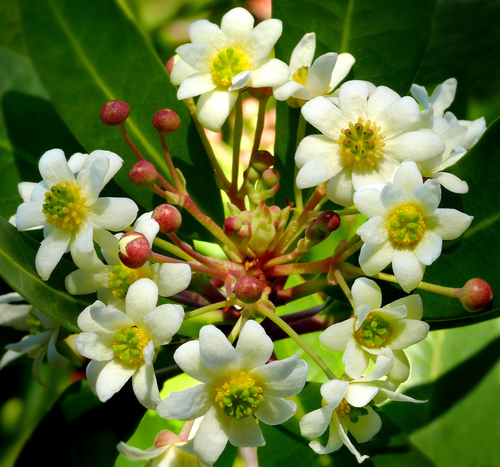
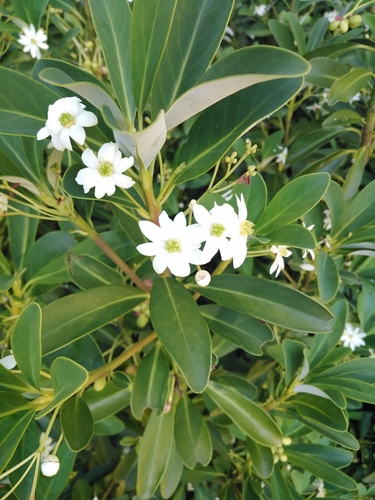
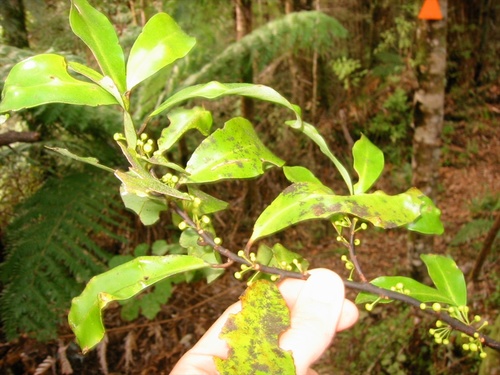
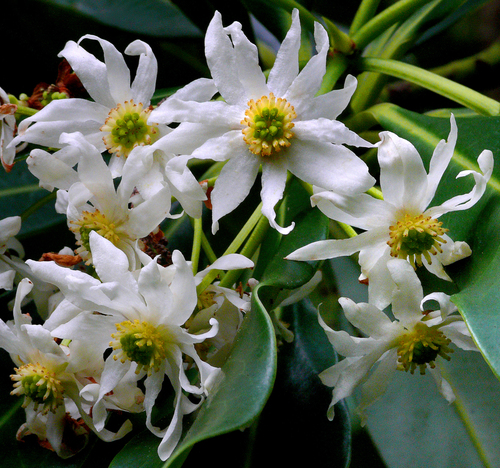
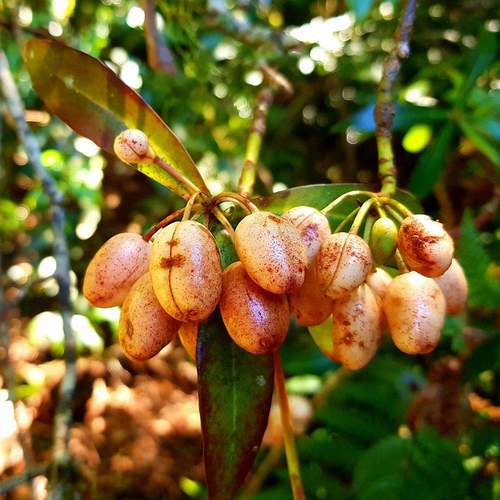
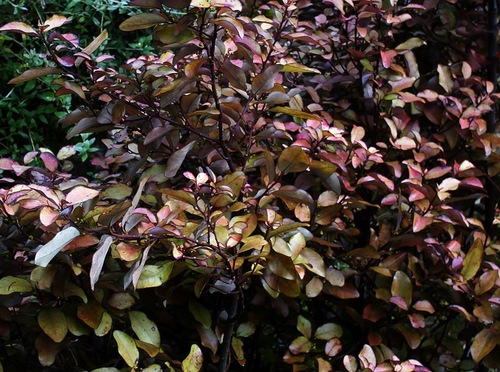
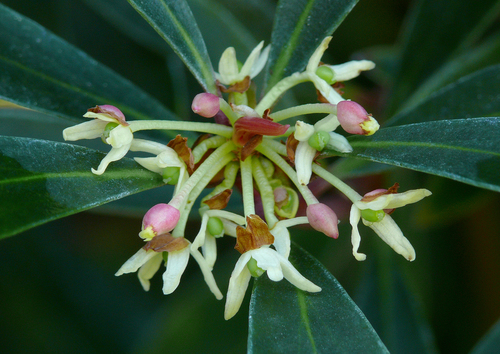
This species is also referenced by the scientific synonym Drimys aromatica (R.Br.) F.Muell., under the accepted name Tasmannia lanceolata. Tasmannia lanceolata is a bushy shrub or small tree that typically reaches 1.5–4 m (4 ft 11 in – 13 ft 1 in) in height, and has smooth, reddish branchlets. Its leaves are lance-shaped to narrowly elliptic, measuring 20–120 mm (0.79–4.72 in) long and 6–35 mm (0.24–1.38 in) wide, growing from a petiole 2–6 mm (0.079–0.236 in) long. Male and female flowers develop on separate individual plants; each flower has 3 to 9 linear or narrowly egg-shaped petals that are 4–10 mm (0.16–0.39 in) long and 1.5–3.5 mm (0.059–0.138 in) wide. Male flowers are borne on a pedicel 8–25 mm (0.31–0.98 in) long, and have 15 to 28 stamens. Female flowers grow on a pedicel 4–12 mm (0.16–0.47 in) long, and have 1 or 2 carpels holding 9 to 18 ovules. Flowering occurs from September to November. The fruit is a spherical, deep maroon to glossy black berry that is 5–10 mm (0.20–0.39 in) long, containing 4 to 18 strongly curved seeds 2.5–3.5 mm (0.098–0.138 in) long. This species grows in forest and temperate rainforest, ranging south from the Blue Mountains in New South Wales, and occurs at altitudes between 300 and 1,400 m (980 to 4,590 ft) in the Australian Capital Territory, Victoria, and Tasmania. Polygodial is the primary active compound identified in Tasmannia lanceolata, and it is also responsible for the plant’s peppery taste. The fruits contain benzoic acids, flavanols, flavanones, eugenol, methyl eugenol, gallic acid, and the glycosides quercetin and rutin; vitamin D may also be present in the fruits. The leaves and berries of this plant have long been dried and used as a spice. The 1889 book The Useful Native Plants of Australia records that the common name of this plant is "Pepper Tree", and that "the drupe is used as a condiment, being a fair substitute for pepper, or rather allspice [...] The leaves and bark also have a hot, biting, cinnamon-like taste." More recently, it has become popularized as a bushfood condiment. It can be added to curries, cheeses, and alcoholic beverages, and it is exported to Japan to flavor wasabi. The berries have a sweet, fruity initial flavor with a lingering peppery aftertaste. Dried T. lanceolata berries and leaves show strong antimicrobial activity against food spoilage organisms, and the plant also has high antioxidant activity. Low safrole clonal selections are grown in plantations for commercial use, as safrole is classified as a low-risk toxin. In colonial medicine, it was used as a substitute for Winter's bark as a stomachic, and it was also used to treat scurvy. Tasmanian pepper, the common name of this species, is one of a number of native Australian herbs and food species supported by Australian Native Food Industry Ltd, an organization that brings together producers of native food species from all regions of Australia. The pepperberry can be used as a fish poison. It can be grown as an ornamental garden plant. Its berries attract birds, including currawongs, that feed on the fruit. It can be propagated from cuttings or seed, and grows in well-drained acidic soil with partial shade, but it is sensitive to Phytophthora cinnamomi. Known garden cultivars include 'Mt. Wellington', a compact plant with coppery new growth, and 'Suzette', a variegated cultivar.