About Drimia exuviata (Jacq.) Jessop
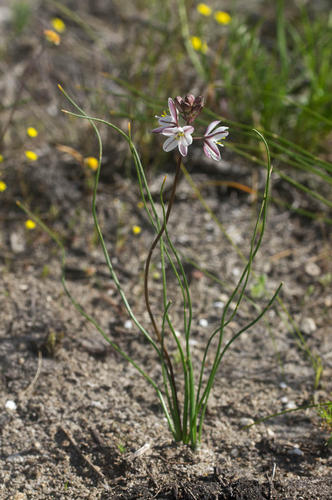
Drimia exuviata (Jacq.) Jessop is a geophytic perennial plant. Its flower stems reach a maximum height of 1 meter, and most grow to around 80 cm. It produces a small number of leaves that are long, slender, 3–4 mm wide, cylindrical, erect, and have a leathery quill-like surface. The basal leaf rosette is enclosed by a grey, papery sheath marked with distinctive horizontal bars. The star-shaped flowers are rose-scented, and are usually white, though they are rarely pink. They bloom between September and October in the southern hemisphere. Each petal has a dark midline, also called a keel. Like most Drimia species, each flower’s pedicel has a distinctively spurred bract at its base. The unique horizontally-banded grey sheath at the base of the leaf rosette is the key feature that distinguishes this species from its closest relatives. This species grows in rocky, loamy soils that are either clay-based or derived from granite, in south-west South Africa. It is common in the Overberg, Robertson Karoo, and West Coast regions of the Western Cape Province. While the center of its distribution lies within Western Cape Province, isolated outlying populations extend east as far as Port Elizabeth, and north into Namaqualand. In the south-western Cape, it grows alongside its smaller relative Drimia filifolia, which has much thinner leaves, around 1 mm wide.