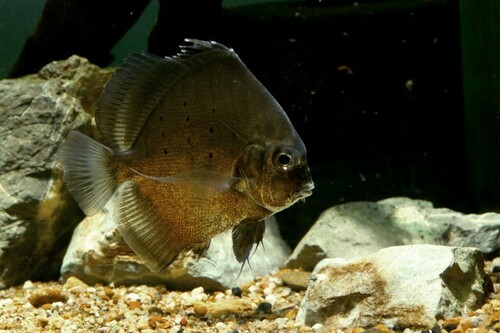
About Drepane punctata (Linnaeus, 1758)
Drepane punctata (Linnaeus, 1758) has an oval, deeply compressed body, with body depth greater than its standard length. Its snout has a straight or concave profile, and no scales grow on the snout, cheeks, or preoperculum. The lower edge of the preoperculum is serrated, and there is a fringe of cirrhi on the chin. This species has a highly protrusible mouth that forms a ventrally facing tube when extended. Bands of thin, pointed teeth grow on the jaws, with no teeth on the roof of the mouth. The dorsal fin is supported by 8 to 10 spines (typically 9) and 20 to 22 soft rays, while the anal fin has 3 spines and 16 to 19 soft rays. The caudal fin is rounded or nearly truncate in larger adults. The long pectoral fins are sickle-shaped and extend as far as the caudal peduncle. There is a bump or bony knob between the eyes. The head and body are silvery, with 5 to 10 series of black spots arranged in vertical lines across the upper body. The fins are dusky yellow; the dorsal and caudal fins are darker toward their margins, and 2 or 3 horizontal rows of dark dots run across these fins, with one dot located on each membrane between the soft rays. The maximum published total length for this species is 50 cm (20 in), though a length of 25 cm (9.8 in) is more typical. Drepane punctata occurs in tropical and temperate regions of the Indo-West Pacific, ranging from India eastward through Indonesia, the Philippines, and New Guinea, north to Taiwan and Japan, and south to northern Australia. It lives at depths between 10 and 49 m (33 and 161 ft), inhabiting coastal waters over sand or mud bottoms in reefs, estuaries, and harbours.


