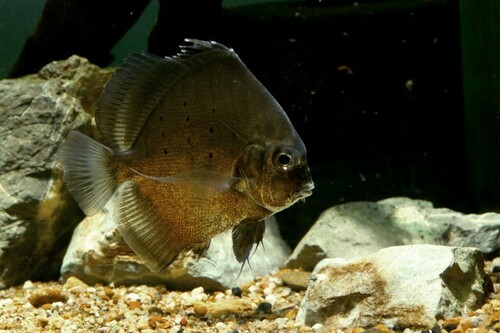
About Drepane africana Osório, 1892
Drepane africana, commonly called the African sicklefish, has a deep, strongly compressed body, with a steep slope along the front of the body from the head to the origin of the dorsal fin. It has a small head with a short snout, and a small terminal mouth with fleshy lips that is highly protrusible. Its teeth are thin and sharp, arranged in bands within the upper jaw, and there are no teeth on the roof of the mouth. The dorsal fin has a deep incision, and is supported by 8 to 9 spines and 17 to 18 soft rays. The forward-pointing first spine is very small, and is only visible in very young fish. The anal fin is supported by 3 spines and 20 to 21 soft rays. The pectoral fins are sickle-shaped, and extend almost to the base of the slightly rounded caudal fin. The pelvic fins are positioned on the thorax. Fine ctenoid scales cover the body, the bases of the dorsal and anal fins, and the head; scales are absent from the snout and preoperculum. The margin of the preoperculum is serrated, and the lateral line forms a strong arch. The overall body color is silvery grey, darker on the upper body and nearly white on the belly. A series of 8 rather indistinct brown vertical bars runs along the flanks, and these bars fade as the fish ages. The maximum published total length for this species is 45 cm (18 in). This fish is found along the western coast of Africa, ranging from the Canary Islands and Mauritania in the north, south to Angola, and also occurs around the Cape Verde Islands. It inhabits depths between 20 and 50 m (66 to 164 ft). It is a neritic coastal species, found in lagoons and estuarine habitats over sandy and muddy bottoms.