About Drepana falcataria (Linnaeus, 1758)
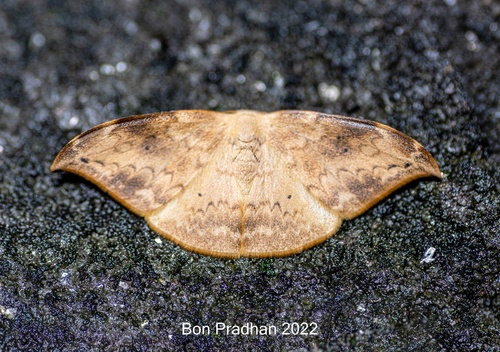
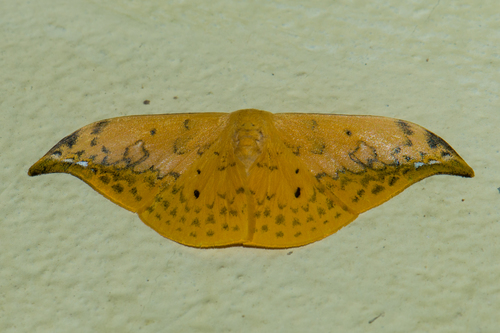
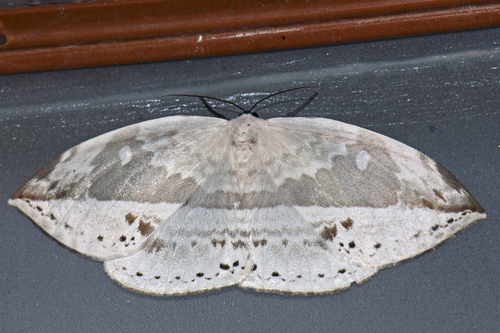
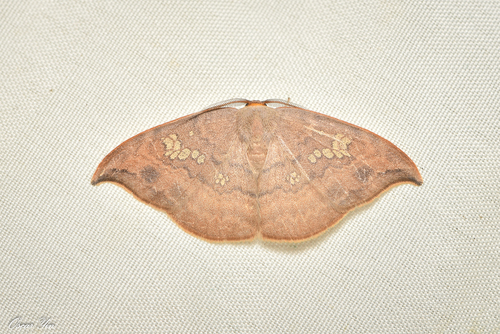
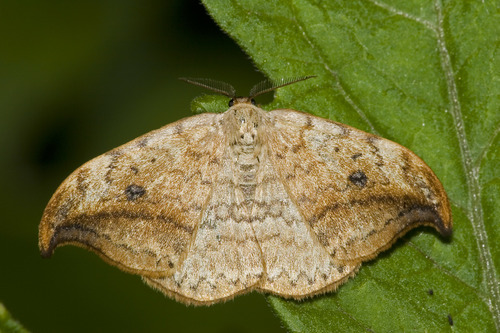
Drepana falcataria, commonly known as the pebble hook-tip, is a moth species belonging to the family Drepanidae. Carl Linnaeus first described this species in the 10th edition of his work Systema Naturae, published in 1758. Its distribution ranges from Europe, across Siberia, to the eastern Palearctic. This moth has a wingspan of 27 to 35 millimeters. The overall ground color of its wings ranges from light brown or whitish brown to reddish brown. The forewings feature a fine, regular pattern of dark, finely serrated lines, plus a dark patch at their center. A purple stain occurs below the hooked wing tip, on the outer portion of the forewing's outer edge. A distinctly curved dark brown band extends from the wing tip, running below the purple stain to the wing edge. The hindwings are also light brown, and are brighter in color than the forewings. Their wing pattern matches that of the forewings, though the markings are less prominent. In female individuals, the hindwings are white with the same dark patterning seen in males. The egg of Drepana falcataria is yellow, with orange marking at one end. The final instar caterpillar is green, with a reddish brown dorsum; this coloration does not extend to its yellowish, black-marked head. Two prominent warts are present on the second and fifth body segments, with less noticeable raised spots on all other segments. All of these outgrowths bear hairs. Younger caterpillars are blackish, with white markings on the fourth and seventh body segments. As they mature, they become greenish on their underside, and the markings on the backs of the fourth, seventh, eighth, and tenth segments become whitish or creamy. This species prefers habitats of riparian forest and carr woodland, but it can also be found at moor edges, and in parks and gardens. It is widespread and common across its range. The adult moth flies from April to August, with flight timing varying by location. The larvae feed on birch, and occasionally feed on alder.