About Dreissena polymorpha (Pallas, 1771)
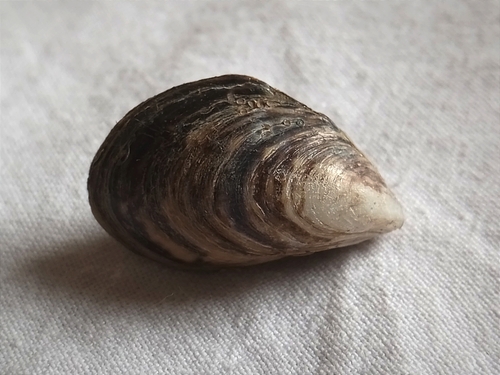
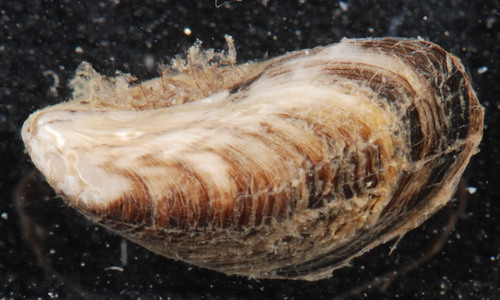
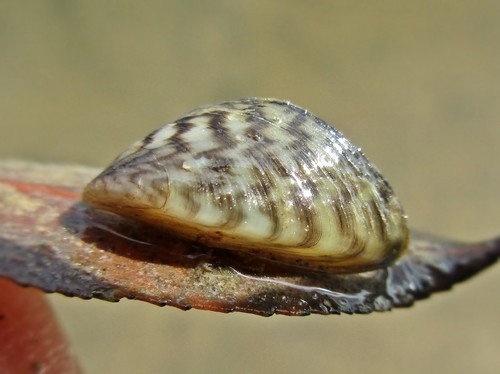
The zebra mussel, with the scientific name Dreissena polymorpha (Pallas, 1771), is a small freshwater mussel, an aquatic bivalve mollusk belonging to the family Dreissenidae. This species is native to the lakes of southwestern Russia and southeastern Europe, but it has been accidentally introduced to many other areas, and has become an invasive species in many Northern Hemisphere countries. Since the 1980s, the species has invaded the Great Lakes, Hudson River, Lake Travis, Finger Lakes, Lake Bonaparte, and Lake Simcoe. Adverse effects of dreissenid mussels on freshwater systems have led to them being ranked as one of the world's most invasive aquatic species. German zoologist Peter Simon Pallas first described this species in 1769, from specimens found in the Ural, Volga, and Dnieper Rivers. Zebra mussels get their common name from the striped shell pattern that is commonly seen on individuals, though this pattern is not present on all zebra mussels. They are typically about the size of a fingernail, but can grow to a maximum length of around 50 mm (2 in). Their shells are D-shaped, and they attach to hard substrates using strong byssal fibers that emerge from their umbo on the dorsal, hinged side of the shell. Zebra mussels and the closely related, ecologically similar quagga mussels are filter-feeding organisms that remove particles from the water column. A single zebra mussel can filter up to 1 litre (0.26 US gal; 34 US fl oz) of water per day. Some filtered particles are consumed as food, and the resulting feces are deposited on the lake floor. Nonfood particles are combined with mucus and other debris, then deposited on lake floors as pseudofeces. Since zebra mussels became established in Lake Erie, water clarity has increased from 6 in (15 cm) to up to 3 ft (0.91 m) in some areas. This increased water clarity lets sunlight penetrate deeper, enabling more growth of submerged macrophytes. When these plants decay, they wash onto shorelines, foul beaches, and cause water quality problems. Zebra mussels enrich food supplies on lake floors as they filter particles and pollution out of the water column. This extra biomass becomes available to bottom-feeding species and the fish that prey on them. After zebra mussels invaded Lake St. Clair, the catch of yellow perch increased five-fold. Zebra mussels will attach to most types of substrates, including sand, silt, and harder substrates. Juvenile zebra mussels usually prefer harder, rockier substrates for attachment. In silty substrates, other native mussel species are often the most stable hard objects available, so zebra mussels attach to these native mussels and frequently kill them. They build dense colonies on native unionid clams, reducing the clams' ability to move, feed, and breed, which eventually leads to the native clams' deaths. This impact has caused unionid clams to become nearly extinct in Lake St. Clair and the western basin of Lake Erie. This same pattern of impact has occurred in Ireland, where zebra mussels have eliminated two native freshwater mussel species from several waterways, including some lakes along the River Shannon, starting in 1997. In 2012, the National University of Ireland, Galway noted that the 1997 discovery of zebra mussels in Lough Derg and the lower Shannon region had led to considerable concern about the potential ecological and economic damage this highly invasive aquatic nuisance species can cause. Zebra mussels are a strictly freshwater species and cannot survive in ocean water. The lifespan of a zebra mussel is three to five years. A female zebra mussel reaches reproductive maturity and begins reproducing within 6–7 weeks after settling. An adult female zebra mussel can produce 30,000 to 40,000 eggs in each reproductive cycle, and over 1 million eggs each year. Free-swimming microscopic larvae called veligers drift in the water for several weeks, then settle onto any hard surface they can find. Zebra mussels can tolerate a wide range of environmental conditions, and adult individuals can even survive out of water for approximately seven days.