About Dreissena bugensis (Andrusov, 1897)
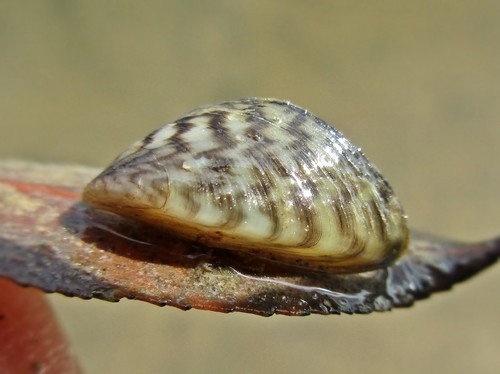
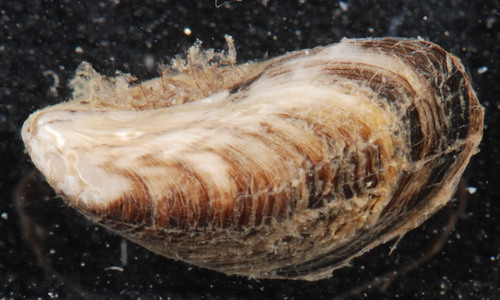
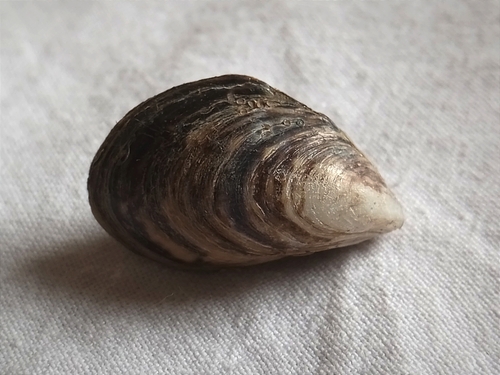
The quagga mussel, with the scientific name Dreissena bugensis, is a freshwater mussel, an aquatic bivalve mollusk that belongs to the family Dreissenidae. It is classified as either a full species or a subspecies. Quagga mussels have a lifespan of 3 to 5 years. This species is native to the Dnipro River drainage of Ukraine. It is named after the quagga, an extinct subspecies of African zebra, and this naming is possibly because, like the quagga, its stripes fade out as they approach the ventral side. The invasive quagga mussel is currently a major source of concern as it spreads through rivers and lakes across Europe, and also through the Great Lakes of North America. It was brought to the North American Great Lakes by overseas shippers that use the Saint Lawrence Seaway. Quagga mussels are prolific breeders, a trait that may contribute to their successful spread and high abundance. All members of the genus Dreissena are dioecious, meaning individuals are either male or female, and they use external fertilization. A fully mature female quagga mussel can produce up to one million eggs per year. After fertilization occurs, pelagic microscopic larvae called veligers develop within a few days. These veligers quickly grow small minute bivalve shells. Free-swimming veligers drift along with currents for 3 to 4 weeks. They feed using hair-like cilia, while searching for a suitable substratum to settle onto and attach to with byssal threads. Mortality during this transitional stage, from planktonic veliger to settled juvenile, can exceed 99%. In 2019, researchers sequenced the genome of a quagga mussel collected from the Danube River in Austria. This sequencing revealed how larvae use a system of intercellular 'cleavage cavities' and an expanded set of aquaporin transmembrane water channels for osmoregulation in low-salinity freshwater environments during the early stages of their development.