About Draco maculatus (Gray, 1845)
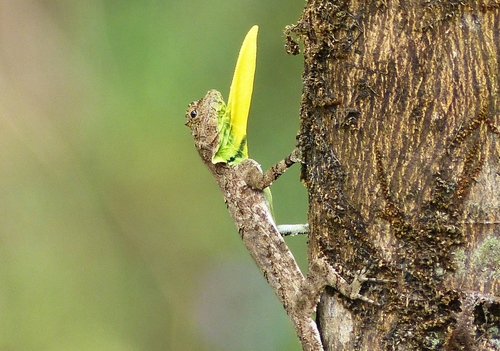
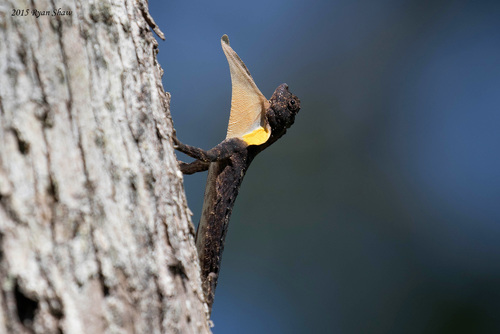
Draco maculatus (Gray, 1845) has a small head, with a snout that is slightly longer than the diameter of the orbit. Its nostril is positioned laterally and directed outwards, and the tympanum is covered in scales. Upper head scales are unequal and strongly keeled, with one compressed, prominent scale located on the posterior part of the superciliary region, and there are 7 to 11 upper labials. Males have a very large gular appendage, which is always much longer than the head, and frequently twice as long as the head. Females also have a well-developed, though smaller, gular sac. Males have a very small nuchal crest. Dorsal scales are only slightly larger than ventral scales, are irregular in shape, and are either smooth or very feebly keeled. On each side of the back runs a series of large, trihedral, keeled, widely spaced scales. When stretched forwards, the fore limb extends beyond the tip of the snout; when held against the body, the hind limb reaches a little past the elbow of the adpressed fore limb, or reaches the axilla. The dorsal body surface is greyish, with more or less distinct darker markings, and a more or less distinct darker interorbital spot. The upper surface of the wing-membranes has numerous small round black spots, which rarely run together; the underside of the wing-membranes is either immaculate or has a small number of black spots. One blue spot is present on each side at the base of the gular appendage. The species measures 82 mm (3.2 in) from snout to vent, with a tail length of 115 mm (4.5 in). Its geographic range extends from Assam and Yunnan to Singapore, including southern China (Hainan, Guangxi, Yunnan, Tibet), India (from the Eastern Himalayas to Assam), Bangladesh (Satchari National Park, Sylhet), Myanmar, Laos, Vietnam, Thailand and Western Malaysia.