About Draco blanfordii Boulenger, 1885
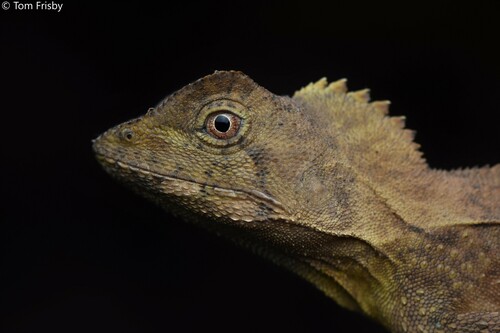
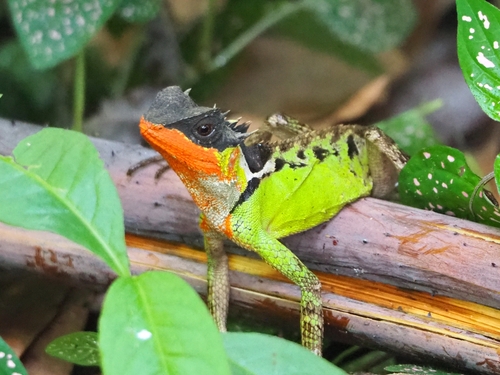
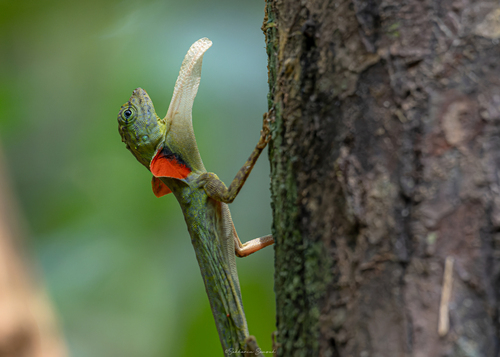
Draco blanfordii Boulenger, 1885 is similar to Draco indochinensis, but can be distinguished by key physical traits. The dewlap of D. indochinensis is widest at its base, narrows along its full length, and ends in a sharp point. In contrast, the dewlap of D. blanfordii is expanded at its distal end, constricted at the base, and ends in a rounded distal edge. Additionally, D. indochinensis has a thick black transverse band across the posterior gular region from one throat lappet to the other in both sexes, and dark radial bands on the dorsal surfaces of the patagia in both sexes rather than only in females, which are not present in D. blanfordii. The head of D. blanfordii is small, and the snout is constricted and slightly longer than the diameter of the orbit. The nostril points directly upward in a perfectly vertical orientation. The tympanum is not covered by scales, and is smaller than the eye opening. Upper head scales are unequal in size and keeled, with a prominent tubercle at the posterior corner of the orbit. There are nine upper labials. The male's gular appendage is longer than the head, very thin, and covered with large scales. Males have a slight nuchal fold. Dorsal scales are equal in size, either smooth or very weakly keeled, and no larger than the ventral scales. A series of widely separated enlarged keeled scales runs along the side of the back. When stretched forward, the fore limb extends considerably past the tip of the snout; when pressed against the body, the hind limb nearly reaches the axilla. The dorsal coloration of D. blanfordii is grey-brown with small dark spots. The upper surfaces of the wing-membranes are marbled with dark brown and marked with lighter spots and lines, while the undersides of the wing-membranes are completely unmarked. The throat is unspotted, greenish, and pale scarlet under the lateral wattles. D. blanfordii is the largest species in its genus: its snout–vent length is 4.75 inches (12.1 cm), and its tail reaches 9 inches (23 cm) long. This species occurs in Bangladesh, southwestern Yunnan (China), India, West Malaysia, Myanmar, eastern Thailand, and Vietnam. Its preferred natural habitat is dense seasonal tropical forest, found at altitudes ranging from sea level up to 1,200 m (3,900 ft). D. blanfordii reproduces via egg-laying (it is oviparous).