About Dracaena reflexa Lam.
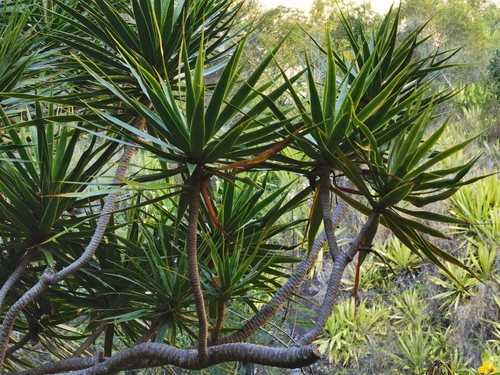
Dracaena reflexa Lam. can grow 4–5 meters tall, reaching 6 meters rarely in ideal, protected locations, but it is usually much smaller, especially when grown as a houseplant. It is a slow-growing, upright plant with an overall oval growth habit. Its leaves are simple, lanceolate, and spirally arranged; they measure 5–20 cm long and 1.5–5 cm wide at the base, have parallel venation and entire margins, grow in tight whorls, and are a uniform dark green. Its flowers are small, clustered, usually white, extremely fragrant, and bloom in mid winter. Neither the flowers nor the fruit of this species are particularly showy. D. reflexa var. angustifolia, which is synonymous with D. marginata, differs from the main species by having magenta-tinted flowers, a shrubby growth habit, and olive green leaves. Dracaena reflexa is a popular ornamental plant, grown both in outdoor landscapes and as an indoor houseplant. It can be used as a specimen plant, a landscape accent, or pruned to form a border. Several cultivars have been selected for cultivation, most notably variegated clones with cream and yellow-green leaf margins. It grows well as a houseplant and tolerates infrequent watering. It prefers bright, filtered light with no direct sun exposure, and can only be grown outdoors in USDA zones 10–11. It has average water needs and should be fertilized bi-weekly during active growth. While it can survive in relatively low light levels, insufficient light causes it to grow spindly. Indoor plants require maintained temperatures between 18 to 25 °C (64 to 77 °F). It can be propagated from herbaceous stem cuttings. The cultivar Dracaena reflexa 'Variegata' has earned the Royal Horticultural Society's Award of Garden Merit, a confirmation that was made in 2017. Traditional medicine practitioners in Madagascar have long believed Dracaena reflexa can cure malarial symptoms, poisoning, dysentery, diarrhea, and dysmenorrhea, and that it works as an antipyretic and hemostatic agent. Its leaves and bark are mixed with parts of many other native plants to make herbal teas. The effectiveness of Dracaena reflexa for any of these medicinal uses has not been proven. The fruit of D. reflexa is an important part of the diet of the Malagasy black-and-white ruffed lemur (Varecia variegata variegata). The Frégate beetle (Polposipus herculeanus), an endangered species endemic to Frégate Island in the Seychelles, is known to associate with this plant. Dracaena reflexa was one of the plants included in the NASA Clean Air Study, which found it helps remove formaldehyde from air. It is an effective air cleaner, and is reported to be among the best plants for removing xylene and trichloroethylene.