About Dracaena fragrans (L.) Ker Gawl.
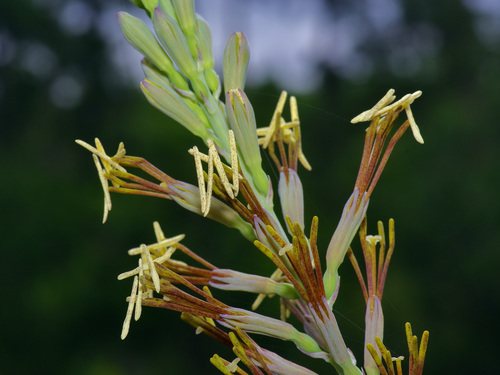
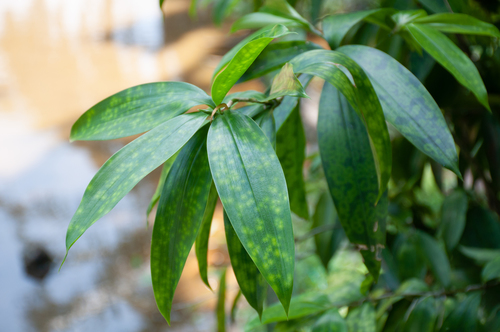
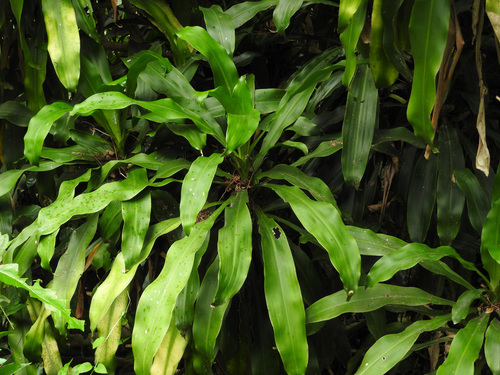
Dracaena fragrans is a slow-growing shrub that is typically multistemmed at its base. Mature plants can reach 15 m (49 ft) or taller, with a narrow crown of usually slender erect branches. On old plants, stems may grow up to 30 cm (12 in) in diameter; in forest habitats, main stems can grow horizontally while producing erect side branches. Young plants have a single unbranched stem that carries a rosette of leaves. Branching only begins after the growing tip either flowers or becomes damaged, at which point the plant produces two or more new stems. Additional branching continues to occur with each subsequent flowering event. If a stem is damaged, it will release red latex. The leaves of Dracaena fragrans are glossy green and lanceolate, measuring 20–150 cm (7.9–59.1 in) in length and 2–12 cm (0.79–4.72 in) in width. Small leaves grow erect to spreading, while larger leaves typically droop under their own weight. Flowers form in panicles that are 15–160 cm (5.9–63.0 in) long. Individual flowers are 2.5 cm (0.98 in) across, with a six-lobed corolla. They start pink, then open white with a thin red or purple central line on each 7–12 mm (0.28–0.47 in) lobe. These flowers are highly fragrant and attractive to pollinating insects. The fruit is an orange-red berry 1–2 cm (0.39–0.79 in) in diameter that contains several seeds. In Africa, D. fragrans is commonly cultivated as a hedge plant. It grows best in frost-free climates, within USDA Hardiness zones 10-11. Outside of its suitable outdoor climate, it is primarily a popular houseplant. It is valued for its ability to tolerate a wide range of indoor conditions, from bright indirect light to bright shade (which increases variegation in certain hybrids) and even deep shade (where it produces darker green foliage). It is also very tolerant of irregular care. The NASA Clean Air Study found that this plant helps remove indoor air pollutants including formaldehyde, xylene, and toluene. However, these results do not translate to typical buildings, as outdoor-to-indoor air exchange already removes volatile organic compounds at a rate that can only be matched by placing 10–1000 plants per square meter of the building's floor space. The Chagga people of Tanzania call this plant "masale" and consider it holy. When cultivated in the Neotropics, a small number of generalist hummingbird species, such as the sapphire-spangled emerald (Chionomesa lactea), visit its flowers.