About Doto coronata (Gmelin, 1791)
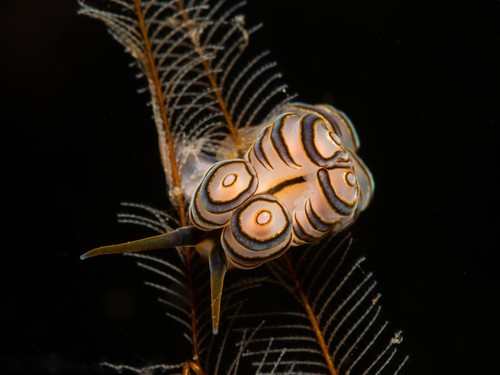
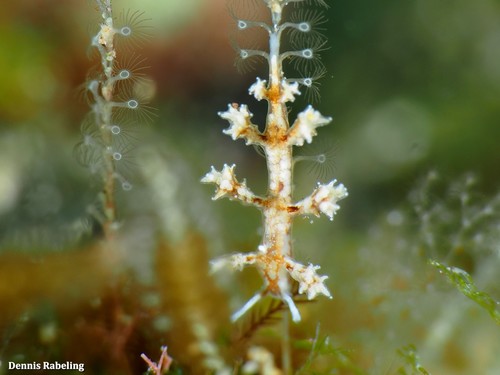
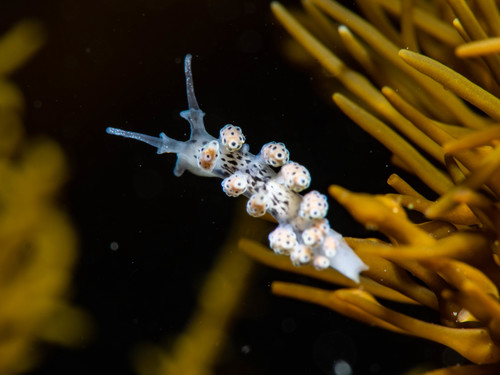
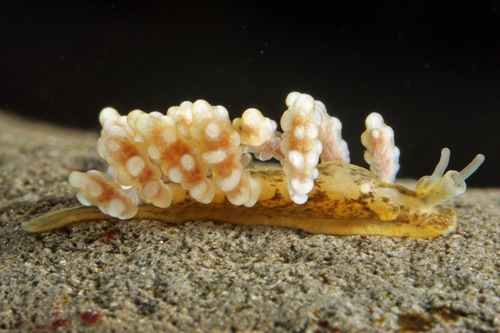
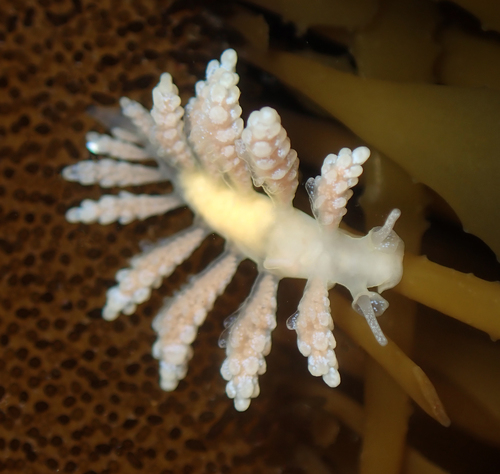
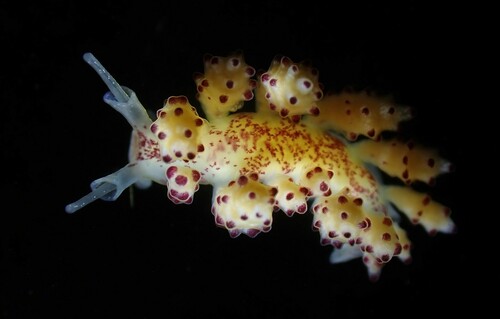
Doto coronata is a small nudibranch species. It has grape-bunch-like clusters of cerata that extend in pairs along the sides of its body. Like all species in the genus Doto, its rhinophores extend from cup-like sheaths. This species is translucent white, with dark red mottling on the back and sides of its body. The tubercles on its cerata are tipped with round red spots, and a patch of dark red pigment appears on the inner faces of the cerata. The maximum recorded body length of Doto coronata is 15 mm.
The type locality of this species is the Dutch coast. In a recent review of the genus Doto, a specimen collected near Goes, Eastern Scheldt, Zeeland was designated as the neotype. Doto coronata has been reported from other areas of the North Atlantic Ocean, including European waters, Canada, and the Gulf of Maine, as well as from the Mediterranean Sea in Greece, but many of these records are likely actually of sibling species. Early erroneous reports placed this species on the South African coast ranging from the Atlantic coast to Knysna; this South African species is now described as Doto africoronata.
The minimum recorded depth for Doto coronata is 4 m, and the maximum recorded depth is 27 m. It feeds on hydroids, especially Obelia spp. from the family Campanulariidae, and Sertularia cupressina from the family Sertulariidae. Its egg mass is a white ribbon laid in a zigzag pattern, usually placed on or at the base of the hydroids it feeds on. This species is a host for three species of parasitic crustaceans: the ectoparasites Doridicola agilis Leydig, 1853 and Splanchnotrophus brevipes Hancock & Norman, 1863, and the endoparasite Lomanoticola brevipes (Hancock & Norman, 1863).