About Dosidicus gigas (D'Orbigny, 1835)
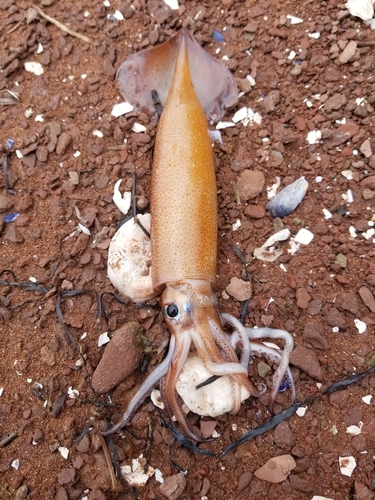
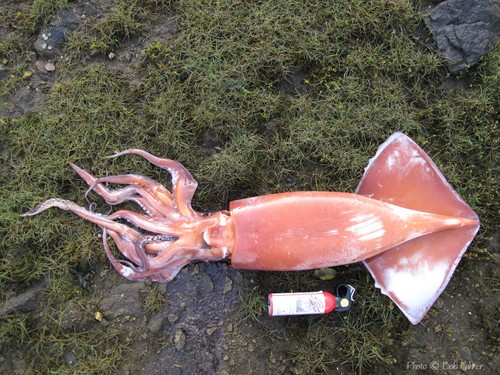
Dosidicus gigas, commonly called the Humboldt squid, is the largest species of ommastrephid squid. Some individuals reach 1.5 m (5 ft) in mantle length and can weigh up to 50 kg (110 lb). This species is sexually dimorphic, with mature females averaging larger in size than mature males. Body mass is distributed across different body parts as follows: the mantle, which includes the body and fins, makes up 56–62% of total mass; arms and tentacles make up 11–15%; the head, including the eyes and beak, makes up 10–13%; the outer cuticle skin makes up 2.5–5.0%; the hepatopancreas, a liver analogue organ, makes up 4.2–5.6%; gonads make up 1.5–15.0% of total mass; the single inner gladius, or 'bone', makes up 0.7–1.0%; the remaining mass belongs to other internal organs. Exact mass ratios vary by the individual squid’s age, sex, and size. Humboldt squid are propelled by water ejected through a hyponome siphon and by their two triangular fins. Their two elastic tentacles can extend rapidly to grab prey, held in place by many suckers that each have an inner ring of teeth. After catching prey, tentacles retract to pull the prey toward the squid’s large, razor-sharp beak. Humboldt squid inhabit depths of 200 to 700 m (660 to 2,300 ft) in the eastern Pacific Ocean, notably off the coasts of Chile and Peru. Their native range extends north from Tierra del Fuego to California, and individuals have recently been found as far north as British Columbia. They have also been observed entering Puget Sound. Though they typically prefer deeper water, between 1,000 and 1,500 Humboldt squid washed ashore on the Long Beach Peninsula in southwest Washington in late 2004. Red algae was speculated as a cause of a 2-month beaching event of juvenile Humboldt squid with an average length of 50 cm (1.5 ft) at Monterey Bay in late 2012, where an unspecified number of individuals stranded. Humboldt squid are generally found in warm Pacific waters off the Mexican coast, and studies published in the early 2000s show an increase in their northern migration. The large 1997–1998 El Niño event led to the first recorded sightings of Humboldt squid in Monterey Bay. During the smaller 2002 El Niño event, they returned to Monterey Bay in higher numbers, and have been observed there year-round ever since. Similar northward shifts have been recorded off the coasts of Washington, Oregon, and even Alaska, though these areas do not host year-round populations of Humboldt squid. This northward migration shift is thought to be caused by warming waters during El Niño events, but other factors such as a decrease in upper trophic level predators that compete with Humboldt squid for food may also contribute. A 2017 Chinese study found that D. gigas populations off the coast of Peru are affected by El Niño events: during El Niño events, squid populations are more dispersed rather than clustering into groups. Additionally, the warm water conditions during El Niño events make Peruvian waters less favorable for D. gigas. Female Humboldt squid produce gelatinous, nearly fully transparent egg masses that float freely in open water. Egg mass size correlates with the size of the female that produces it: large females can lay egg masses up to 3–4 m (10–13 ft) in diameter, while smaller females lay egg masses around one meter (3+1⁄4 ft) in diameter. Records of wild Humboldt squid egg masses are extremely rare because they are seldom encountered by humans. From the few recorded specimens, egg masses hold between 5,000 and 4.1 million eggs, depending on their size. Fresh Humboldt squid flesh contains high amounts of ammonium chloride, which the squid uses to maintain neutral buoyancy in seawater, giving fresh flesh an unpleasantly salty, sour, bitter taste similar to salmiak. To make Humboldt squid palatable for the frozen market, commercial processors use a specific preparation method: freshly caught squid are first mechanically tenderized, submerged in icy water mixed with a 1% combination of lactic and citric acid for three hours, washed, then soaked in a 6% brine solution for another three hours. An alternative preparation method exists for home cooks to neutralize the unpleasant taste. Compared to other seafood, Humboldt squid is low-priced along its native South American Pacific coastline; in the early 2010s, it retailed for around US$0.30 per kilogram in Peru, and around US$2.00 per kilogram in Chile. In Chile, Humboldt squid is used in dishes like chupes and paila marina. In Peru, using this inexpensive squid to make ceviche began in poor communities of Lima after the meat became widely available in the 1990s, and the practice has since spread to Cuzco. It is sold from street food carts as well as cevicherias, restaurants that specialize in ceviche. In the United States, it is processed into 'squid steaks'.