About Doryfera ludovicae (Bourcier & Mulsant, 1847)
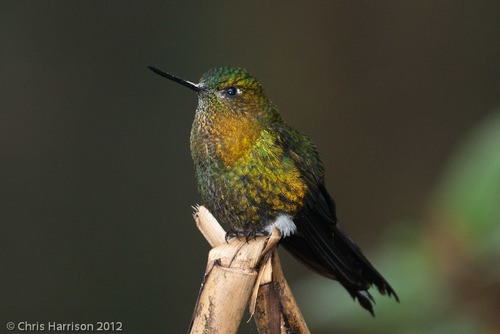
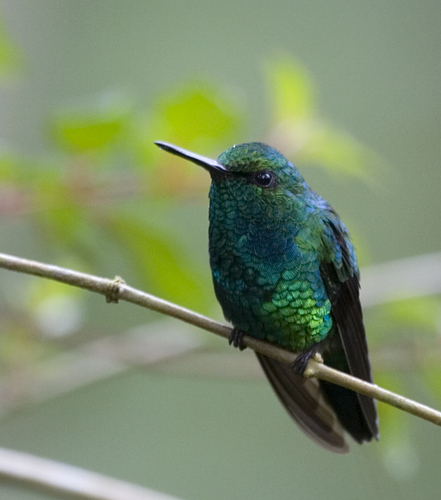
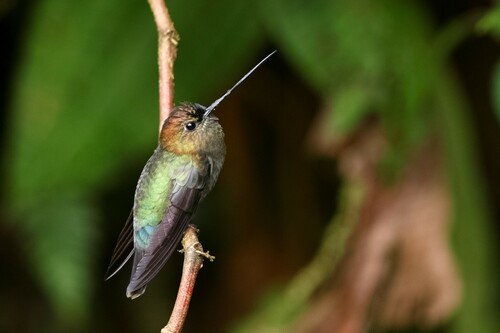
This species is the green-fronted lancebill, with the scientific name Doryfera ludovicae (Bourcier & Mulsant, 1847). As its common name suggests, it is distinguished by a glittering green patch of feathers on the forehead. Males consistently have a prominent forehead patch, but published sources disagree on the appearance of female green-fronted lancebills. One notable source reports that females can vary widely between individuals: in terms of both feather development and color intensity, a female's forehead patch can range from barely visible to indistinguishable from the typical male plumage. Body plumage is the same regardless of sex; both males and females have a drab grey-green breast and belly. A coppery patch extends from the nape down along the sides of the neck, which meets a rich green color that covers most of the crown, excluding the namesake green forehead patch. Most of the back and the dorsal surface of the tail are a similar rich green, with an iridescence that creates an alternation between green, teal, and turquoise depending on viewing conditions. The other defining feature of the green-fronted lancebill is its namesake bill. The bill is exceptionally long for a hummingbird, ranging from 29mm to 36.5mm, with most of this variation coming from differences between regional populations. This long bill is the inspiration for the genus name Doryfera, which translates roughly to "spear bearer". No size difference between males and females has been identified for body length or beak proportions. The green-fronted lancebill has a disjunct distribution, occurring in the Talamancan montane forests, the Serranía del Darién, and the northern Andes. It is not considered a migratory species. This species and its sister species Doryfera johannae live in mature forest areas next to fast-moving streams. It is theorized that the species' specific habitat needs cause it to concentrate around ideal sites, rather than spreading evenly across forested mountainsides.