About Doryanthes excelsa Corrêa
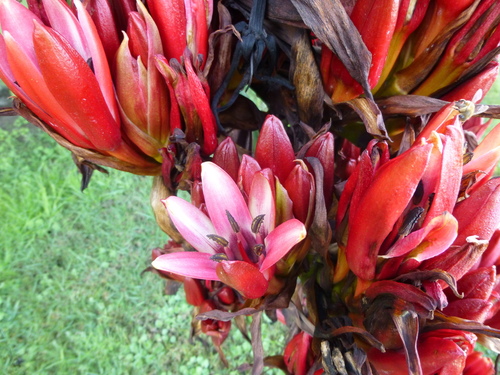
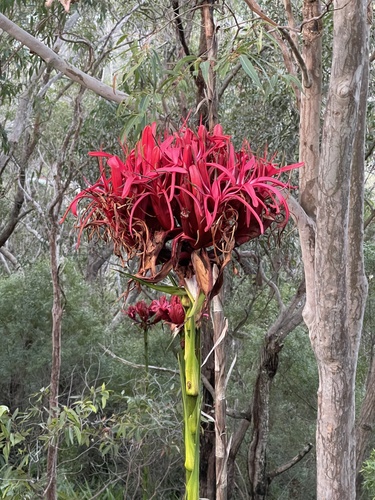
Gymea lilies (Doryanthes excelsa Corrêa) form a rosette of many bright green, fibrous, glabrous, sword-shaped, strap-like leaves. Individual leaves grow 1 to 2.5 metres (3 to 8 feet) long and up to 10 centimetres (4 inches) wide. In winter, a flower spike grows from the center of the leaf rosette, reaching up to 6 metres (20 feet) tall. This spike bears shorter leaves that can grow up to 30 centimetres (10 inches) long. A dense cluster of flowers, 30 centimetres (10 inches) in diameter, develops at the top of the spike. Each flower is bright red, trumpet-shaped, and about 10 centimetres (4 inches) long. The flower cluster is surrounded by reddish-brown bracts, which sometimes make the flowers difficult to see from the ground. Flowering takes place in spring, and after flowering the plant produces oval-shaped reddish-brown seed capsules that are 7 to 10 centimetres (3 to 4 inches) long. In late summer, the capsules split open to release seeds that measure 15 to 23 millimetres (0.6 to 0.9 inches) long. The flowers are pollinated by bees and nectar-feeding birds. Doryanthes excelsa requires very specific conditions to grow well. It needs low-nutrient, acidic sandy loam soils with a pH of approximately 4.1 that are moderately deep. It grows specifically on south- or southeast-facing slopes, along creeks, in gullies, or on sheltered plateaus and ridges, at elevations between 100 and 200 metres above sea level. This species grows in open dry sclerophyll forests that also host Angophora costata, Eucalyptus piperita, E. gummifera, E. sieberi, or E. punctata, as well as in habitats with Xanthorrhoea, Telopea, and moisture-preferring groundcover plants. Doryanthes excelsa has a discontinuous distribution along the coast of New South Wales. It occurs from Corindi, north of Coffs Harbour, in the north, through areas surrounding Newcastle (including Awaba), down to Wollongong in the south. It does not grow directly east or west of Sydney's urbanized areas. Documented locations where it occurs include Newfoundland State Forest, Kremnos Creek just north of Glenreagh, Karuah, Nelson Bay, Somersby, Calga, Lucas Heights, Heathcote National Park, Darkes Forest, Dharug National Park, and Royal National Park. The isolated northernmost populations, located north of Coffs Harbour, are the most genetically divergent. Aboriginal people have used gymea lily traditionally: they roasted the young stems for food, roasted the roots to prepare a type of cake, and used leaf fibres to make brushes and matting.