About Dorosoma cepedianum (Lesueur, 1818)
Scientific name: Dorosoma cepedianum (Lesueur, 1818), commonly known as gizzard shad.
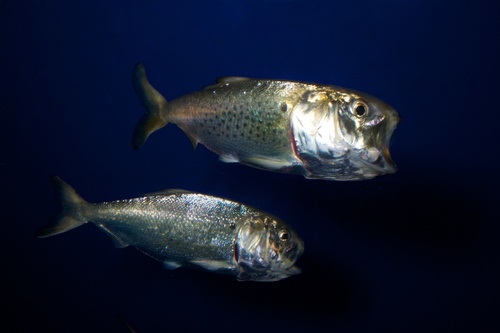
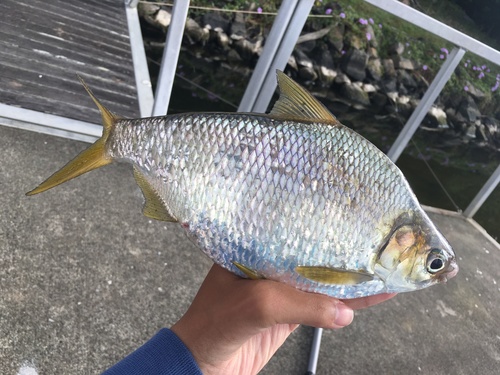
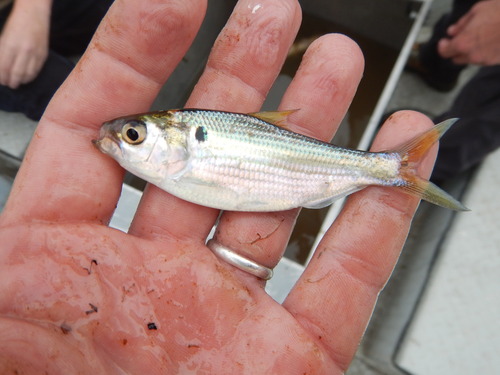
Description The dorsal fin of gizzard shad begins behind the insertion point of the pelvic fins, and its last ray is greatly lengthened. They have a long anal fin with 25 to 36 long soft rays. The gizzard shad's mouth has a short, wide upper jaw with a deep notch along its ventral margin, and a weak, relatively smaller lower jaw. The mouth itself is subterminal to inferior, meaning it sits on the lower portion of the head, and adult gizzard shad have no teeth. This species also has 90 to 275 gill rakers along the lower gill limbs. Their ventral pelvic fins are located in the thoracic position, that is, in the chest region of the fish.
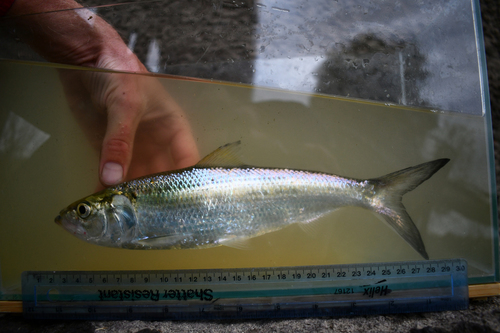
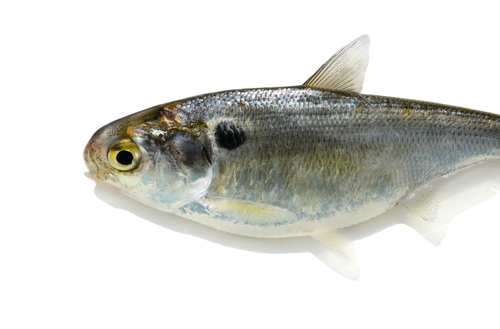
When young fry, gizzard shad are very small, growing to a maximum recorded length of 477 mm (18.8 in) and a maximum recorded weight of 1.56 kg (3.4 lb). Average length is typically larger in northern waters, ranging from 284 mm (11.2 in) at three years of age to 399 mm (15.7 in) at 10 years of age. They have a branched lateral line system confined to the head and anterior body, a feature shared with other clupeids. Dorsally, gizzard shad are brown or gray, fading to whitish on their ventral side. A humeral spot, which sometimes has purple iridescence, may be faintly visible posterior to the upper operculum. The fish is often covered in slime.
Distribution and habitat Historically, gizzard shad ranged from North Dakota in the northwestern United States south to New Mexico in the southwest, east to Florida in the southeast, and north to 40°N latitude, with no historical records of individuals farther north than lower New York Harbor. They were not recorded in many of the Great Lakes until the late 1800s and early 1900s, although they are suspected to be native to Lake Erie, having reached the lake after the last ice age.
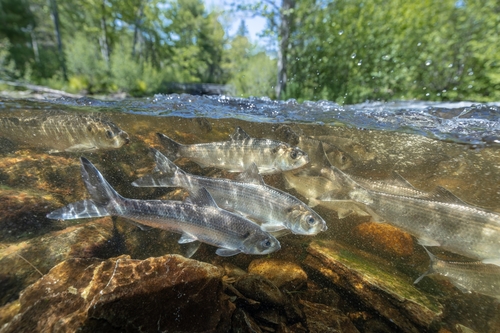
Gizzard shad typically inhabit lakes and reservoirs, but they can also live in rivers, streams, and brackish waters. They reside in the limnetic zone, and can make up as much as 80% of total fish biomass in some lake systems. They prefer shallow lakes with muddy bottoms and relatively high turbidity. This preference may be partially due to their breeding requirements, but it most likely comes from their lower survival rates in clear waters and waters with dense vegetative cover.
Reproduction Spawning typically begins between mid-May and early June, triggered by rising water temperatures. The number of eggs produced per individual varies between populations, but two-year-old fish usually produce around 12,500 eggs, and fecundity peaks at 380,000 eggs for four-year-old fish. Eggs are laid in clumps in shallow water, with no observed pairing between individuals. Gizzard shad spawn during the evening and early night, and eggs adhere to underwater vegetation with no parental care provided. Feeding begins three to four days after hatching, and most hatchlings measure 3.3 mm long when they emerge. Gizzard shad have very high fecundity and a rapid growth rate, which allows them to become a large component of an ecosystem, in terms of both abundance and biomass, very quickly. They are capable of hybridizing with the closely related threadfin shad (Dorosoma petenense).
Ecology Gizzard shad can increase ecosystem productivity by redistributing nutrients, particularly during their adult stage. Adults consume detritus in deeper regions of lakes, making the detritus available to predatory species and excreting nutrients in forms that are more bioavailable to other organisms. Because of this effect, gizzard shad can have a strong impact on algal production even when phosphorus loading from watersheds is high, and they can counteract management efforts aimed at reducing cultural eutrophication.