About Doris verrucosa Linnaeus, 1758
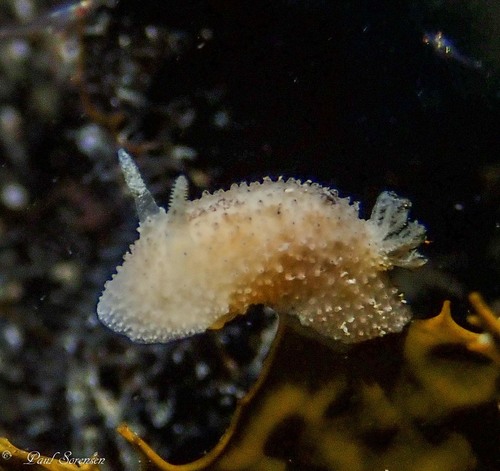
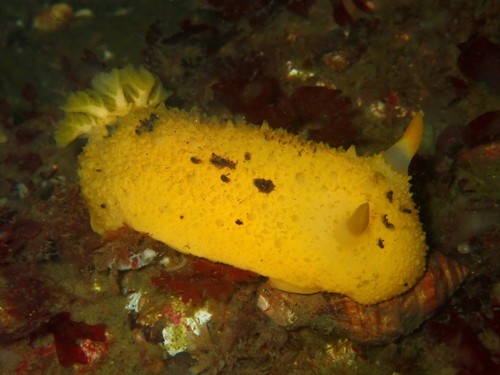
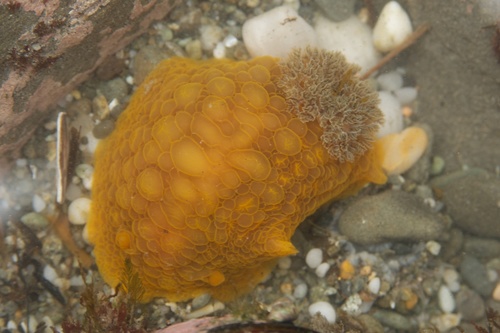
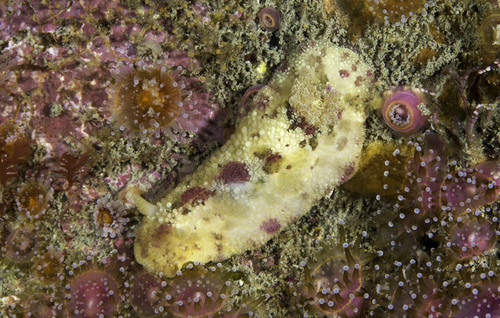
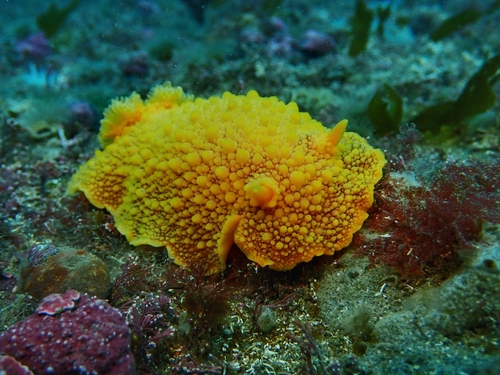
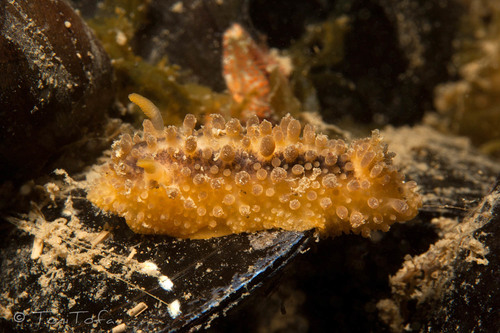
Doris verrucosa, first described by Linnaeus in 1758, is a yellow-brown, oval-shaped nudibranch with distinctive warty skin. It has eight gills arranged around the anus, and its rhinophores are perfoliate. Individuals found in South Africa can grow to a total length of 30 mm, while the maximum recorded length for the species is 70 mm. This species is distributed in the Mediterranean Sea and the Atlantic Ocean off the coasts of France, Spain, the United Kingdom, and Ireland. It has been reported from South Africa, where it is commonly called the warty dorid, but the South African population may actually be a separate, closely related species. Confirmed records of this species from the coast of Brazil have been shown to instead represent the separate species Doris januarii. In South Africa, the warty dorid feeds on the crumb-of-bread sponge Hymeniacidon cf. perlevis, and its body colour closely matches the colour of this sponge. It produces an egg mass shaped as a tall upright collar formed of several complete whorls. It has been recorded living from the intertidal zone down to a depth of 14 m.