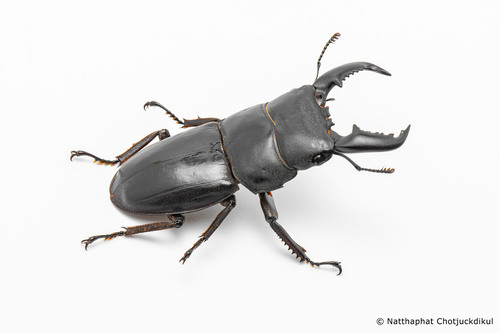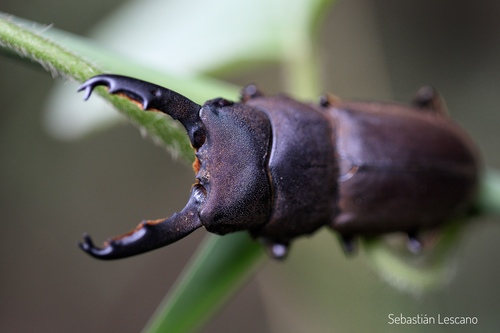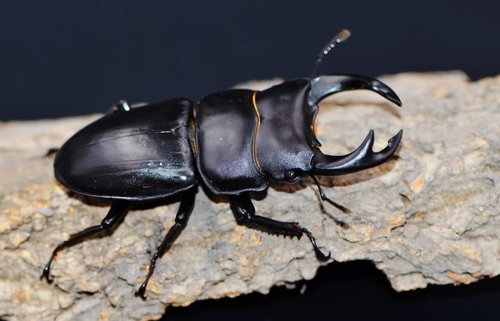
About Dorcus hopei (Saunders, 1854)
Dorcus hopei is a species of beetle belonging to the family Lucanidae, the stag beetles. Its overall life history is fairly similar to that of other members of the Lucanidae family. The species has a multi-stage life cycle, starting with eggs laid in decaying wood logs in forested habitats across China, Korea, and Japan. Larvae spend around one to two years in this developmental stage. To feed on decaying wood, larvae rely on yeast from the genus Pichia, which breaks down xylose found in rotting wood. This larval stage has a unique adaptation to survive the harsh winters of the species' native range: larvae can survive temperatures as low as -15°C for 24 hours, thanks to unique antifreeze proteins. These proteins are not found in any close relatives of D. hopei within Lucanidae, and are present in very few insects overall. This adaptation lets D. hopei overwinter through cold seasons in its native range of China, Korea, and Japan.
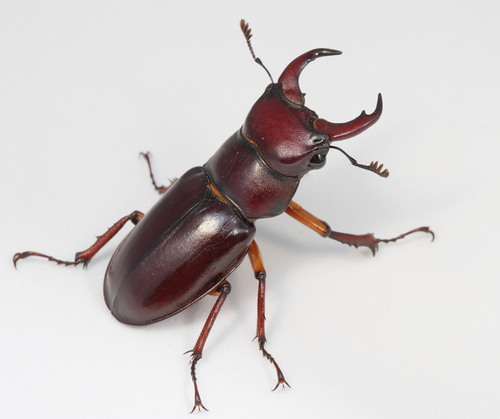
Adults live for around three to five years, and typically stay on forest floors. The species exhibits sexual dimorphism, and males and females often differ in their behavior. Males display variable mandible sizes, a common trait among stag beetles, and their behavior changes based on mandible size: larger-mandibled males use their mandibles to gain control of reproductive territories and food sources. D. hopei has become popular as a pet insect in Japan and Korea, kept for its distinct mandibles and easy cultivation. This popularity has supported a large stag beetle market in Japan, worth up to $283 million.
Studies of D. hopei reproduction have found that males and females typically mate on oak trees within their forest habitat. Females lay eggs one at a time, and a single female produces around 25 eggs total. Eggs are laid on wood substrates, which provide an immediate food source for newly hatched larvae. Like many other stag beetles, D. hopei larvae cannot digest rotting wood on their own, and require yeast or other microorganisms to process this food source. Wood is not a highly nutritious food source, so these beetles also feed on fungi that grow on decaying wood. They use digestive enzymes to break down the chitinous cell material of fungi to get nutrients. Research into larval population density in Lucanidae shows that D. hopei larvae generally do not interact with conspecifics or other species. However, cannibalism may occur in areas with very high larval population density.