About Dondice occidentalis (Engel, 1925)
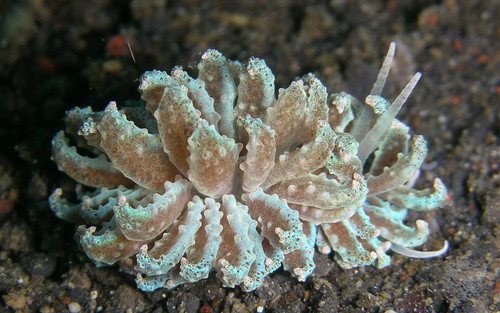
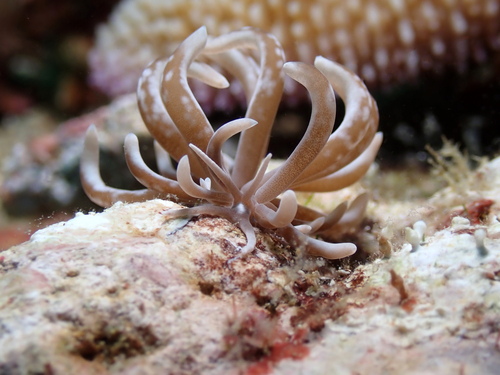
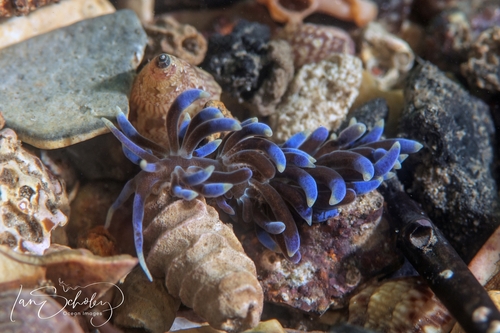
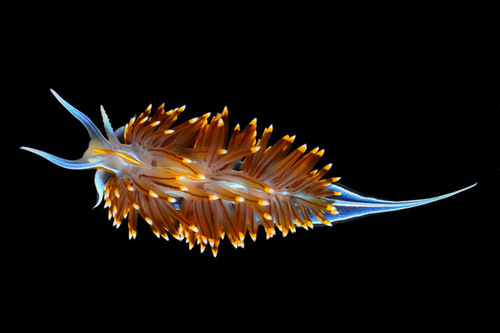
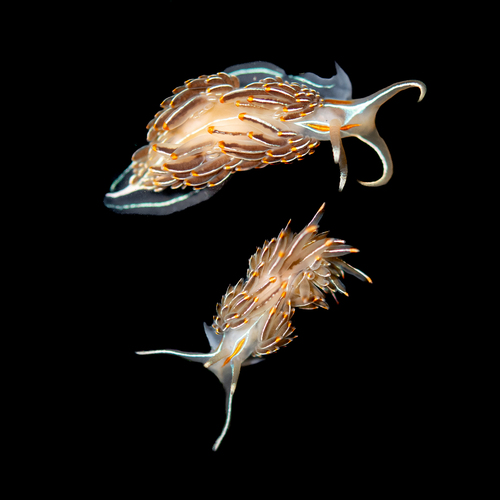
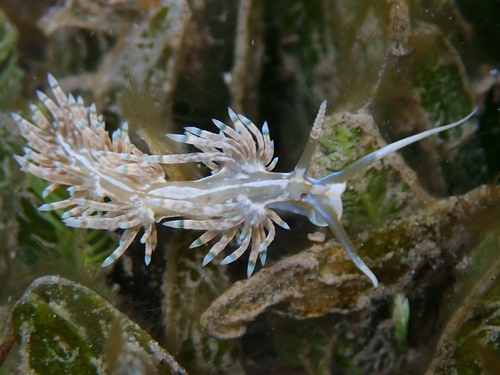
Dondice occidentalis has an elongated body that tapers toward the posterior end. Its rhinophores are long and annulate, while its oral tentacles are longer than the rhinophores. Cerata are arranged in clusters along two rows on the dorsum. The background body color is translucent gray, with a variable-width yellow or orange median line that runs from the head to the anterior end, between the rhinophores. A broken white or blue line is sometimes present along the dorsal midline, extending from behind the rhinophores to the posterior end of the body. Opaque white spots may also appear on the dorsum. The oral tentacles are translucent or light blue at the base, and fade to white toward the tips. The cerata are translucent gray, and often have large blue or white bands covering the upper two-thirds of each ceras. The maximum recorded body length of this species is 50 mm. Dondice occidentalis is distributed across Florida, Mexico, Belize, Costa Rica, Colombia, Venezuela, Curaçao, Bonaire, Bermudas, Bahamas, Cayman Islands, Jamaica, Turks and Caicos, Grenada, Sint Maarten, Martinique, Trinidad, Brazil and Panama. It has been recorded at depths ranging from the surface to 26 metres. In Panama, this species was found on hydroids, where it feeds on hydroids of the genus Eudendrium and apparently the bryozoan Amathia. It easily sheds its cerata when disturbed.