About Donax vittatus (da Costa, 1778)
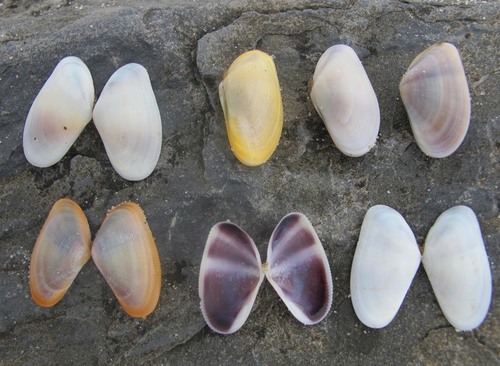
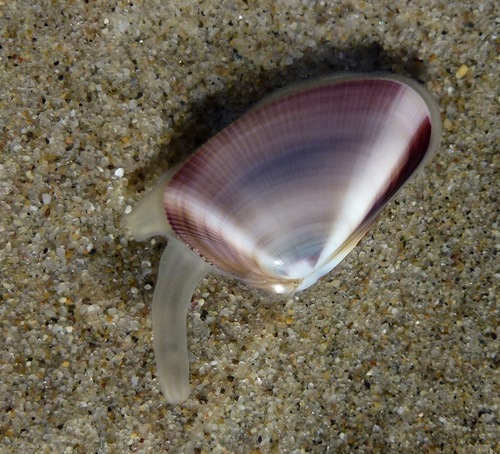
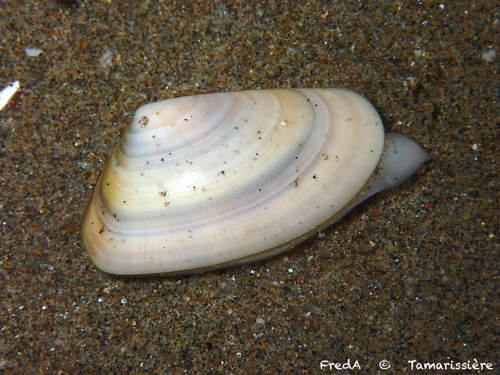
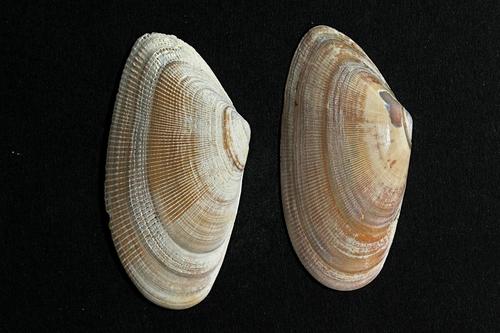
Donax vittatus, also known by its scientific name Donax vittatus (da Costa, 1778), has laterally compressed shells that reach 1.3 inches (33 mm) in length and 0.6 inches (15 mm) in width. Its shell valves are delicate, glossy, and display a wide variety of colors: white, yellow, brown, pink, and violet. The interior of the shell is white, often marked with violet blotches. The valves are asymmetric and wedge-shaped; the anterior end is rounded and longer than the obliquely truncated posterior end. Fine sculpturing of transverse and longitudinal grooves covers the valves, and the shell margin is finely serrated. Annual growth rings are visible on the shell, and these rings are often more deeply pigmented than the rest of the shell. Pale radial rays may also be present. On the inner surface of the shell, muscle scars are indistinct, and the oval pallial sinus reaches the middle of the valve. The right valve holds two cardinal teeth, one posterior tooth, and two lateral teeth, while the left valve has two cardinal teeth, with one lateral tooth flanking each side. The fringed mantle and strong muscular foot are mauve or reddish, and the pair of short, separate siphons are orange. This species is found in the Mediterranean Sea and the eastern Atlantic Ocean, ranging from Norway and the Baltic Sea south to Spain and northwest Africa. It burrows in sand on exposed beaches, from the middle shore down to the shallow sublittoral, and it is common in suitable habitats around the shores of the British Isles.