About Dolichovespula saxonica (Fabricius, 1793)
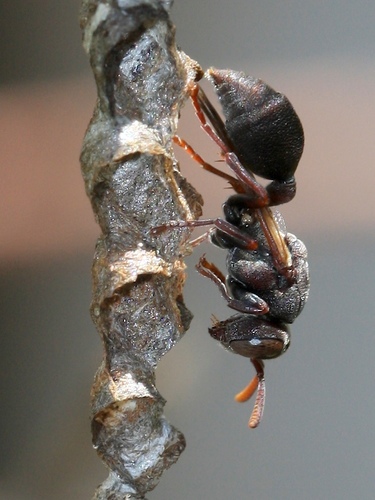
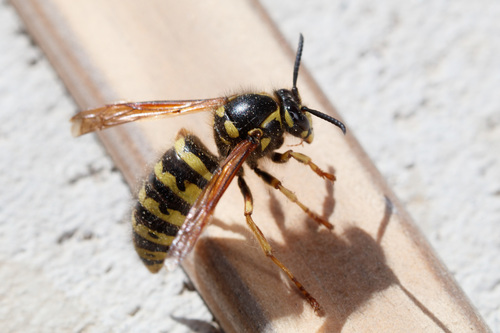
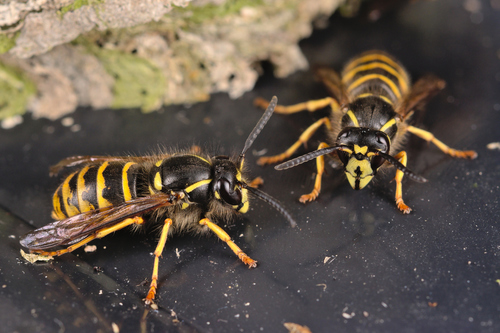
Dolichovespula saxonica, commonly called the Saxon wasp, shares the characteristic black and yellow body stripes of its yellowjacket relatives, but is larger than most of these close relatives. Body size differs by caste: queens range from 15 to 19 mm (0.59 to 0.75 in) in body length, males range from 13 to 15 mm (0.51 to 0.59 in), and workers range from 11 to 15 mm (0.43 to 0.59 in). Males have seven gastral tergites (hardened dorsal sclerites) and ventral sternites, plus a copulatory casing at the tip of the gaster. Females have six gastral tergites and sternites, and a sting at the tip of the gaster. The Saxon wasp is an aerial nester, meaning it builds its nests above ground. Nests are most often placed in trees, shrubs, or on buildings. They are ball-shaped, reaching roughly 250 mm (9.8 in), which is small compared to the nests of other wasp species. Nests are constructed quickly, which allows the nest population to grow rapidly. On average, nests hold three to five combs, and large nests can hold up to five combs. Saxon wasps build nests from rotting wood, using wood fibers to create a grey nest that may have yellow lines or patches on its outer surface. The outside of the nest is smooth and lacks ventilation holes. Instead, there is a single opening at the bottom of the nest that wasps use to enter and exit, and that waste leaves through. The Saxon wasp is commonly found across most of Europe, as well as in northern and central Asia. Confirmed common locations include only southern United Kingdom, the Czech Republic, northern France, the Netherlands, and (most recently, in 2020) eastern Ireland. Within its range, Saxon wasp nests hang freely in various forest types, open countryside, and wooded hills. As aerial nesters, their nests typically hang from tree branches or shrubs a couple of meters above ground. Urban areas also make suitable habitat for this species, so their nests are often found under roofs, under porches, on park benches, and on the sides of buildings. Despite this flexibility in nesting site selection, subterranean nests are rarely found.