About Dolichovespula maculata (Linnaeus, 1763)
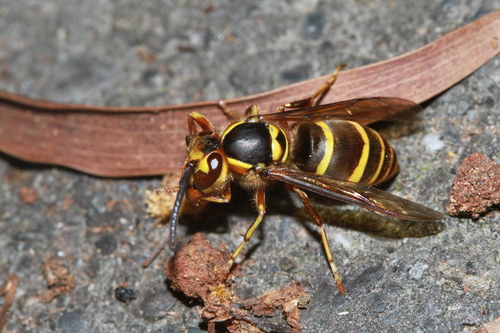
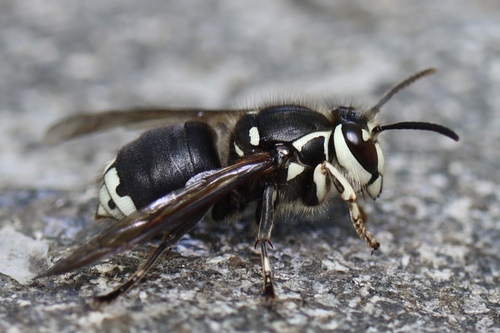
The bald-faced hornet (Dolichovespula maculata) can be distinguished from other yellowjackets by its bold black-and-white coloration. Its common name comes from its white, or "bald-faced" head. This wasp species also has three white stripes at the tip of its body, and is noticeably larger than other species in the Dolichovespula genus: adult bald-faced hornets average around 19 mm (0.75 in) in length. Queens and workers share similar overall body shape, though queens are always larger than workers within the same colony. Size distributions can vary between different nests, however, and workers from one colony may be as large as queens from another colony. D. maculata builds egg-shaped paper nests that can reach up to 360 mm (14 in) in diameter and 580 mm (23 in) in length. Nests are made of layered hexagonal combs, covered by a mottled gray paper outer envelope. To create this paper envelope, bald-faced hornets collect and chew natural wood fibers, mix the fiber with their saliva to make a pulp, then shape the pulp into place. The bald-faced hornet is native to North America, where it occurs across Canada, the Rocky Mountains, the western coast of the United States, and most of the eastern United States. It is most common in the Southeastern United States. D. maculata lives in forested areas and urban vegetation. Nests are most often built in trees and bushes, but are occasionally found under rock overhangs or on the sides of buildings. Recorded nest heights above ground range from 0.3 m (1 ft 0 in) to 20 m (65 ft 7 in). A bald-faced hornet colony is split into three groups: haploid males, female workers, and one or more reproductive queens. All female D. maculata are born with the capacity to reproduce. The genus Dolichovespula differs from its sister genus Vespula in that some Dolichovespula workers produce haploid offspring that develop into males. Caste membership is determined by the feeding regimen individuals receive as larvae. In a study by G. T. Felippotti et al, researchers examined caste distribution among females in five small-cell colonies and six large-cell colonies. Small-cell colonies contained one queen and 17 to 21 female workers. Large-cell colonies contained two to six queens and 10 to 52 workers. Morphological comparisons from this study confirmed that queens are always larger than workers within the same colony. Each spring, mature queens that mated at the end of the previous season establish new colonies. A founding queen chooses a nest site, starts building the nest, lays her first batch of eggs, and feeds the first group of larvae. These first offspring become workers, which then take over the task of expanding the nest. Workers chew wood, mix it with starch from their saliva, spread the mixture with their mandibles and legs, and allow it to dry into a papery structure. Workers guard the nest, and feed on nectar, tree sap, and fruit pulp (especially apple pulp). They also hunt insects and other arthropods, which they chew up to feed to the colony's larvae. They have also been recorded scavenging raw meat. In late summer and early fall, the queen begins laying eggs that develop into fertile males (drones) and new reproductive queens. After pupation, these mature fertile males and females leave the nest to mate. Fertilized queens then overwinter to start new colonies the following year. Males and workers die at the end of the annual colony cycle. If the old founding queen is not killed by the colony's workers, she dies along with them by mid-autumn.