About Dolichotis patagonum (Zimmermann, 1780)
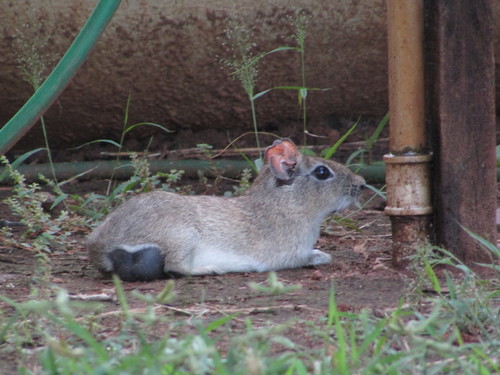
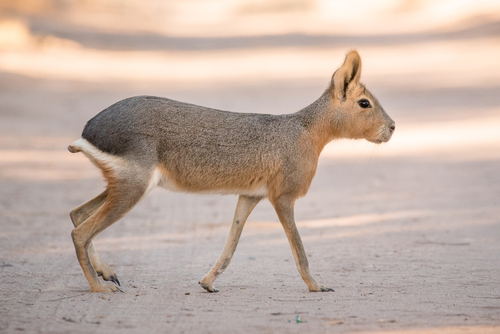
The Patagonian mara, whose scientific name is Dolichotis patagonum (Zimmermann, 1780), resembles a jackrabbit. It has distinctive upright ears and long limbs. Its hind limbs are longer and more muscular than its fore limbs, and it has a longer radius than humerus. Its feet are compressed, which makes them hoof-like. This foot shape contributes to Patagonian maras looking like small ungulates, especially when they stand or walk. The fore feet have four digits, while the hind feet have three digits. Its tail is short, depressed, and hairless. It has a gray dorsal fur coat, with a white patch on the rump that is separated from the dorsal fur by a black area. In addition, the mara has a white underside, with a somewhat orange flank and chin. The average Patagonian mara has a head and body length of 69–75 cm (27–30 in), with a tail 4–5 cm (1.6–2.0 in) long. It weighs 8–16 kg (18–35 lb). Unlike most other caviids, such as guinea pigs and capybaras, the anal glands of the mara are located between the anus and the base of the tail, rather than anterior to the anus.
Patagonian maras are found only in Argentina, between 28 and 50°S. They prefer to live in habitats with shrub cover, but they also inhabit overgrazed and barren soils in the Monte Desert biome. In northwestern Argentina, they primarily live in lowland habitats such as forest and areas with creosote bush (also called Larrea). On Valdes Peninsula, maras prefer sandy, low-shrub habitat. They have adapted well to a cursorial, or running-based, lifestyle on open plains and steppe. Their long legs, reduced clavicle, and well-developed sensory organs let them run and communicate effectively in these open habitats. When running, maras have been compared to deer and antelope.
Maras are largely herbivorous. They feed primarily on green vegetation and fruit. In the Monte Desert, monocots make up 70% of their diet, while dicots make up 30%. Their preferred grass species belong to the genera Chloris, Pappophorum, and Trichloris. The dicots they eat include Atriplex lampa, Lycium species, and Prosopis species.
Maras are primarily diurnal, and around 46% of their daily activity is spent feeding. Their activity patterns over time are linked to environmental factors: light, precipitation, and temperature have positive effects on their annual activity levels, while darkness and relative humidity have negative effects. The mara's daily activity pattern is unimodal (having a single peak) in winter, and bimodal (having two peaks) in other seasons. Their preferred temperature is around 20 °C (68 °F). Females spend more time feeding than males, due to the energy demands of gestation and lactation. Males spend most of the day sitting and acting vigilant against predators. Predators of maras, especially young maras, include felids, grisons, foxes, and birds of prey. Maras also serve as hosts for parasites such as the nematode worm Wellcomia dolichotis.
Their social organization features a unique combination of monogamy and communal breeding. As monogamous animals, pairs of maras stay together for life; partners are only replaced after one individual dies. The male holds almost sole responsibility for maintaining the pair bond, following the female wherever she goes. A male marks his female with urine, and marks the ground around her with gland secretions and feces, turning the area around the female into a mobile territory. Pairs breed either alone or alongside other pairs in shared warrens that can hold up to 29 pairs. At least in southern Argentina, maras breed from August to January. In the wild, gestation lasts 100 days. Most births in Patagonia occur between September and October, which is before the summer dry season and after the winter rains. In the wild, females produce one litter each year, but in captivity they can produce as many as four litters per year. Young maras can walk almost immediately after birth.
Dens are dug during the breeding season to raise young. Litters from one to 22 pairs are grouped together inside these dens. Communal living provides protection from predators, and the survival rate for young is higher in larger groups than smaller groups. One pair visits the den at a time for around one hour, while other parents circle around the outside of the den. A female nurses one or two pups at a time. A female may sometimes nurse a young from another pair. While a female may prevent young other than her own from nursing from her, some young are able to steal milk. Mothers do not actively cooperate to raise each other's young. For the first three weeks, young stay near the den. During this time, the distance between individual pups is small, with frequent body contact, huddling, allogrooming, and extended play among the pups. After three weeks, the young are able to leave the den and graze alongside their parents. Young are weaned after 13 weeks.
Maras make a number of vocalizations during grazing or slow movement. When seeking contact, a mara emits an inflected "wheet", while a low, repetitive grunt is produced when following another mara. When threatened, maras chatter their teeth and emit low grunts. They also produce a series of short grunts when grooming. Scent marking is used by maras for complex, intense social interactions. Maras stretch and sniff the soil, then sit upright with an arched back and the anogenital area flattened against the ground, a behavior called anal digging. In addition, a male will stand on his hind legs and urinate on a female's rump. The female responds to this by spraying a jet of urine backwards into the male's face. The male's urination is meant to repel other males away from his partner, while the female's urination acts as a rejection of any approaching male when she is not receptive. Both anal digging and urination are more common during the breeding season, and are more frequently performed by males.