About Dolichophis caspius (Gmelin, 1789)
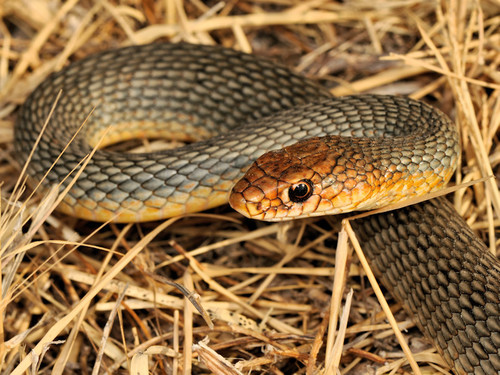
The Caspian whipsnake, scientific name Dolichophis caspius (Gmelin, 1789), is possibly the largest snake species native to Europe. It typically reaches 140–160 cm (55–63 in) in length, though a small number of individuals grow longer than 200 cm (79 in), and the maximum recorded specimen measured approximately 250 cm (98 in). Adult body mass commonly ranges from 120 to 673 g (4.2 to 23.7 oz). This species is non-venomous and primarily active during the day. Its head connects to the body via a thick neck, and it has round pupils. Nineteen rows of smooth scales cover the midbody, though seventeen rows occur rarely. Each dorsal scale has two apical pits at its posterior edge, and the center of each scale is lighter in color than its edges. The dorsal body is grey-brown, with distinct markings that are prominent in juvenile and young snakes and fade as the snakes age. The ventral side is light yellow or white. The Caspian whipsnake occurs across the Balkan peninsula, parts of Eastern Europe, and a small section of Asia Minor, with confirmed populations in Albania, Bulgaria, Greece, North Macedonia, Serbia, Romania, Croatia, Turkey, Moldova, Montenegro, southern Ukraine, southern Russia, Kazakhstan, and southern Hungary. Survey results show its habitats are often distributed across low-lying areas near major rivers, including the Danube and the Olt River. It was previously considered extinct in the historical region of Moldavia — covering eastern Romania, southern Ukraine, and western Moldova — where it was only known from two sites and had not been observed since 1937. The collection of three specimens in Galați County in May 2007 disproved this assumption of local extinction. While the species is confirmed to be common in the Dobrudja area, there is limited information about its distribution in other regions, where it is thought to be very rare and potentially highly threatened. National legislation classifies D. caspius as a species of community interest requiring strict protection. In Hungary, the species was formerly thought to only occur in two areas: one near the capital Budapest, and another near Szársomlyó. A recent regional survey identified multiple previously unknown habitats for the species along the River Danube, including sites near Dunaújváros and Dunaföldvár. As in Romania, D. caspius is a protected species in Hungary. Recently observed Caspian whipsnake specimens have been found in open grassy areas with sparse shrubbery, as well as open, bushy areas between the Danube Meadow and the Romanian Plain, near Căscioarele. Vine-covered areas are also found near this habitat type. At Drăgăneşti Olt, the species was recorded on a hilly slope. Additional suitable habitats for the species include rocky riverbanks, swampy areas, gardens, and cemeteries.