About Dolichonyx oryzivorus (Linnaeus, 1758)
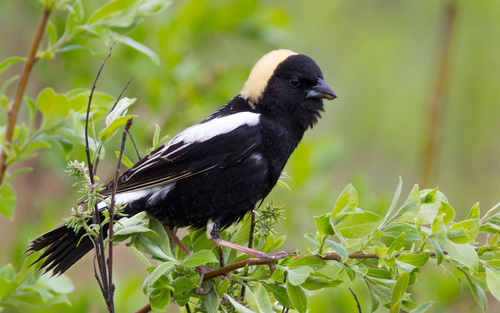
This species has the scientific name Dolichonyx oryzivorus (Linnaeus, 1758), commonly called the bobolink. Measurements of the species note an overall length range of 5.9–8.3 inches (15–21 cm), a weight range of 1.0–2.0 ounces (28–57 g), and an average wingspan of 10.6 inches (27 cm). Adults are specifically 16–18 cm (6.3–7.1 in) long, have short finch-like bills, and weigh approximately 28 g (1 oz). Adult males are mostly black, with creamy napes and white scapulars, lower backs, and rumps. Adult females are mostly light brown, with black streaks on the back and flanks, dark stripes on the head, and darker wings and tails. The bobolink breeds during the summer in North America, across most of southern Canada and the northern United States. From 1966 to 2015, the species saw an annual population decrease of more than 1.5% across most of its breeding range, which stretches from the Midwestern United States to the Canadian Maritimes. The bobolink is a long-distance migrant, and spends its winters in southern South America. One individual was tracked completing a 12,000 mi (19,000 km) migration over a full year; it often flew distances as long as 1,100 mi (1,800 km) in a single day, then stopped to recover for periods of days or weeks. Bobolinks usually migrate in flocks, and feed on cultivated grains and rice, which leads to them being classified as a pest by farmers in some regions. Even though they migrate over long distances, bobolinks have very rarely been observed in Europe; as with many American vagrant species, most European records come from the British Isles. In the southern United States, this species has long been known as "reedbird" or "ricebird", because it eats large amounts of rice grain from rice fields in South Carolina and the Gulf States during its fall southward migration. One of the species' main migration routes passes through Jamaica, where it is called "butter-bird". Historically, at least, bobolinks were collected for food there, since they become fattened from feeding on rice. Bobolinks are the only land bird species documented to annually migrate through the Galápagos Islands, which lie more than 2,000 km from their primary migration route. In 1835, Charles Darwin collected a bobolink specimen in the Galápagos Islands. It has been hypothesized that bobolinks act as vectors that carry avian malaria-causing parasites into the Galápagos Islands. Additionally, bobolinks found in the Galápagos have had seeds from Drymaria cordata entangled in their feathers. This plant is native to the Galápagos but is highly invasive in other regions, so bobolinks may potentially spread these seeds to the mainland.