About Dodonaea sinuolata J.G.West
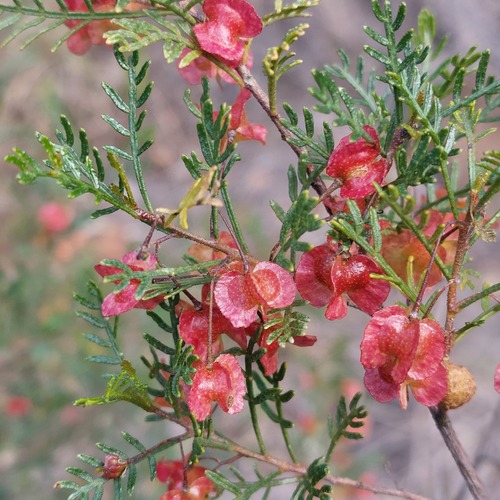
Dodonaea sinuolata is a spreading, dioecious shrub that usually reaches a maximum height of 3 m (9.8 ft). Its leaves are imparipinnate, measuring 14–28 mm (0.55–1.10 in) in total length, and grow from a petiole 6–20 mm (0.24–0.79 in) long. Most leaves bear 8 to 14 linear to lance-shaped side leaflets, which are narrower at the base, 5–15.5 mm (0.20–0.61 in) long and 1–2 mm (0.039–0.079 in) wide, and sometimes have wavy or toothed edges. The end leaflet is similar in form to the side leaflets, but is shorter and lobe-shaped. Flowers are arranged as cymes of 3 or 4 that grow in leaf axils, and each individual flower sits on a pedicel 4.5–10 mm (0.18–0.39 in) long. The flowers have four egg-shaped sepals 1.7–3 mm (0.067–0.118 in) long that detach as the flowers open. Each flower has eight stamens and a glabrous ovary. The fruit is a glabrous, broadly elliptic capsule that is usually four-winged. It is 9.5–13 mm (0.37–0.51 in) long and 10–15 mm (0.39–0.59 in) wide, with leathery wings 3–5.5 mm (0.12–0.22 in) wide. Subspecies acrodentata grows in red sandy loam on stony ridges in arid and semi-arid areas between Thargomindah, St George and Tambo in Queensland, with one isolated population near Hillston in New South Wales. Subspecies sinuolata grows on rocky sites in open forest or woodland between Scone, the Warrumbungles in New South Wales and Chinchilla in Queensland.