About Dodecatheon poeticum L.F.Hend.
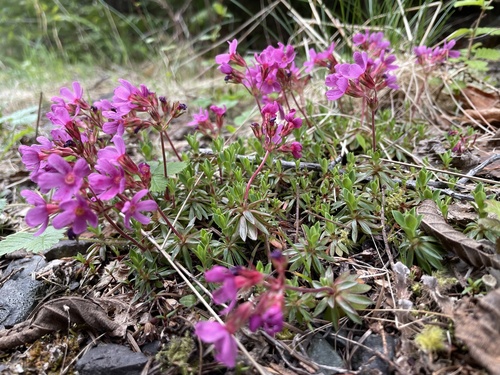
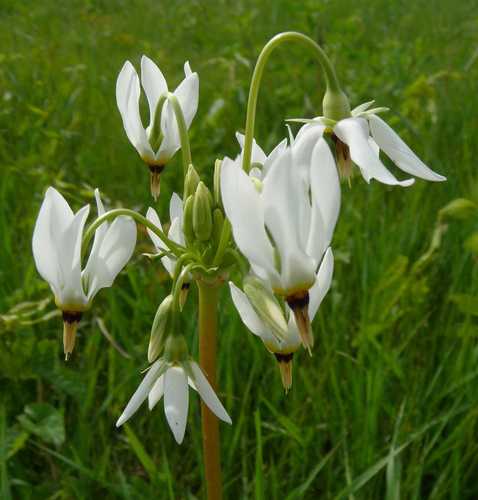
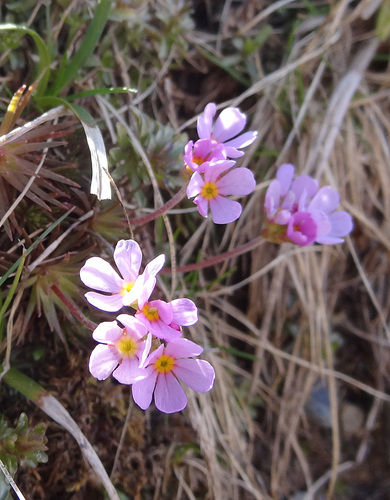
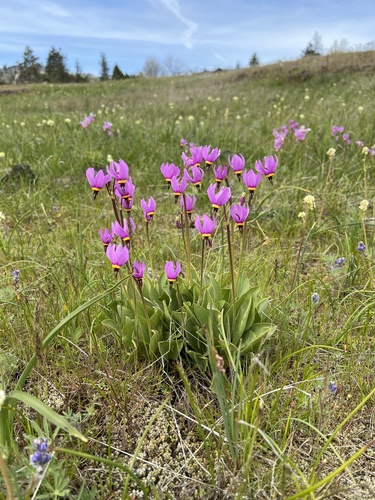
This species, also known by the scientific synonym Dodecatheon poeticum L.F.Hend. and the accepted name Primula poetica, produces erect stems and leaves, growing from a root system with many fibrous roots that become fleshy during flowering. All above-ground flower parts except the corolla are glandular and covered in fine short hairs. Its leaves are arranged in alternate, opposite, or whorled patterns. Leaf shape ranges from entire to lobed, and they measure 5 to 12 centimeters in length. Leaf shape varies from narrowly egg-shaped (with the widest portion below the middle) to narrowly lance-shaped. Leaf margins of P. poetica are more finely toothed than those of Primula latiloba, which has the synonym Dodecatheon dentatum. The petioles of P. poetica are approximately the same length as the leaf blade, or shorter. The unusual petals are curved, and most often display bright shades of pink to lavender. The corolla is five-lobed, matching the structure of P. latiloba; many other species in Primula sect. Dodecatheon have only four corolla lobes. The bisexual flower (containing both stamens and pistils) is deep purple. The corolla is yellow at its base and dark purple at its upper portion. Flowers droop slightly. As the plant ages and dies, seed capsules become fully erect, ripen, and release seeds to produce new plants in the next growing season. Primula poetica is primarily found in the northwestern United States, concentrated in the arid transition zone of Washington and Oregon. Compared to other members of its genus, it grows in more open, sunny areas and drier woodlands. It occasionally grows under the shade of Ponderosa pines, but is most common in open meadows with plentiful sunshine. It is also widely distributed along petroleum seep sites. This species thrives in habitats that get abundant spring moisture followed by dry summer conditions. It prefers growing in regions with soil made of rich humus and wind-deposited fine sand in the Columbia River Gorge. It typically occurs at altitudes between 0 and 1,677 meters.