About Dodecatheon hendersonii subsp. hendersonii
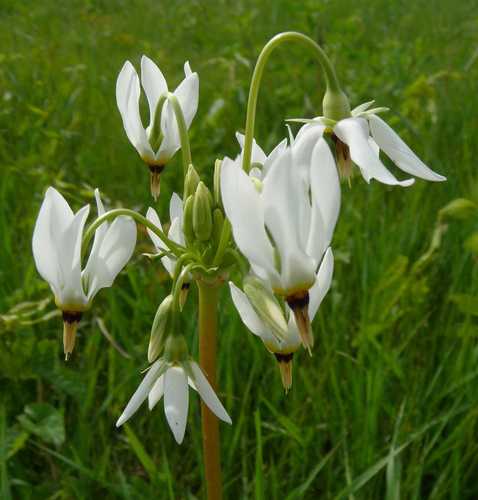
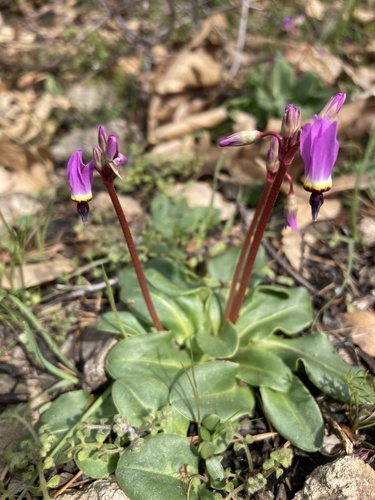
Dodecatheon hendersonii subsp. hendersonii (also referenced as P. hendersonii) is summer deciduous, dying back completely to the ground after rains stop. It grows in basal clumps of leaves, with individual leaves reaching 2–16 cm in length. Nodding flowers 6–25 mm long bloom on stems that grow 10–30 cm tall. Flower colors range from magenta to deep lavender to white, with protruding stamens and bent-back sepals. This subspecies is highly variable, and hybridizes with Primula clevelandii. It can be distinguished from Primula clevelandii by its reddish or purplish stem. In California, it occurs in the northwest (excluding the north coast), the Cascade Range, the Sierra Nevada foothills, the Central Valley, the San Francisco Bay Area, the north Inner South Coast Ranges, and the San Bernardino Mountains. It is most commonly found in open woodlands, growing from sea level in British Columbia up to 1,900 m (6,234 ft) in altitude within California. For cultivation, this plant requires good drainage and a dry summer period. Seed-germinated plants typically take 3–5 years to produce flowers. When grown with frequent light fertilization and consistent moisture, dormancy may be delayed, and flowering can occur as early as 1–2 years after germination. Another method to speed up flowering is to store the plants in a cool location after they enter dormancy, then move them to a shadehouse in midsummer. It can also be propagated via division during winter. In inland locations, it prefers growing in shade. Its leaves and roots are edible after roasting or boiling, but are reported to be poisonous when consumed raw.