About Dixeia pigea (Boisduval, 1836)
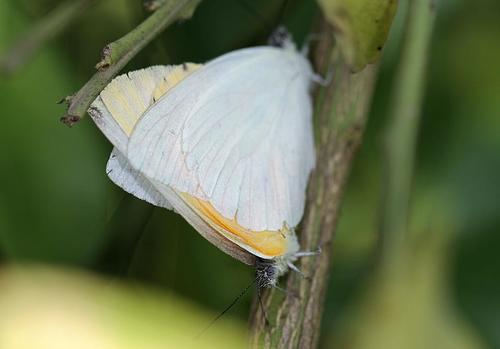
Dixeia pigea, first described by Boisduval in 1836, shows sexual dimorphism in wing measurements and appearance. Males have a wingspan of 40 to 48 millimetres, while females have a wingspan of 40 to 52 millimetres. On males, the upper wing surface is pure white, with a narrow black marking on the tip of the forewing and small black dots along the margin of the hindwing. The underside of male wings is whitish, with two rows of black spots on the hindwings; the inner row of these spots is sometimes absent or incomplete. Females have multiple distinct colour forms, but most have a pale yellowish white upper wing surface with heavier black markings than males, plus a dark spot on each forewing. One rare female form, called luteola, has an orange yellow or deep apricot upper wing surface. The underside of female wings is similar to that of males, but the rows of black dots are more prominent, and the base colour ranges from pale to bright yellow. Another rare form, rubrobasalis, has orange suffusion at the base of the forewing underside, and a creamy-yellow upper wing surface. The dry-season form, alba, has reduced black markings. A key distinguishing feature that sets D. pigea apart from all other Dixeia species is the yellow streak on the costal of the hindwing. This species is distributed from Eastern Cape province of South Africa, through KwaZulu-Natal, Eswatini, Mpumalanga and Limpopo Province, to Mozambique, Zimbabwe, Ethiopia, the Democratic Republic of the Congo, Angola and Cameroon.