About Diurnea fagella (Fabricius, 1787)
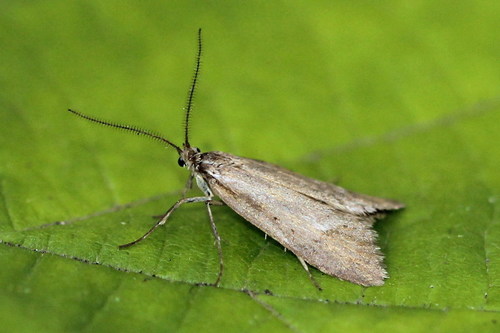
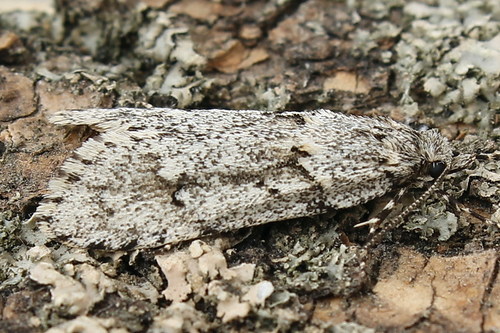
Diurnea fagella, first described by Fabricius in 1787, shows clear sexual dimorphism in size and wing development. Males have a wingspan of 26–30 mm, while smaller females have reduced wings with a 15–20 mm wingspan. Male antennae are short and evenly ciliated. Forewings are whitish or ochreous whitish, sprinkled or sometimes densely irrorated with fuscous and dark fuscous scales. An indistinct blackish angulated transverse line runs around one-third of the wing length, and does not reach the dorsum. Stigmata are black: the first discal stigma is double, followed by an additional black dot; the plical stigma is confluent with the transverse line; the second discal stigma forms a transverse mark or pair of dots. An angulated and indented blackish subterminal line is often present. Hindwings are light grey. The larva is grey-green with a yellowish-grey head, and its third pair of legs is positioned on a tubercle. Melanic forms are common in both sexes, occurring in some northern and industrial areas of England. Only pale specimens are found in northern Scotland, and albinistic forms occur across the species' range. This moth produces one generation per year, with adults flying from March to May, varying by location. During the day, males rest on tree trunks; the smaller female can be found low on trunks at nightfall. Eggs are laid between March and May in batches of 100 or more on the twigs or shoots of many deciduous tree and shrub species, including aspen (Populus tremula), beech (Fagus sylvatica), birch (Betula species), blackberry (Rubus fruticosus), blackthorn (Prunus spinosa), bullrush (Typha species), field maple (Acer campestre), hawthorn (Crataegus monogyna), hazel (Corylus avellana), hornbeam (Carpinus betulus), oak (Quercus species), poplar (Populus species), and willow (Salix species). In their final instar, larvae measure around 25 mm long, and may grow up to 28 mm. The larval body is pale greyish green, the head is yellowish orange, and the prothoracic plate is translucent green, sometimes with a faint brown ochre lateral mark. These polyphagous larvae feed between leaves that are spun flat together on many deciduous trees and shrubs. They develop very slowly from late May to September or early October. Pupation occurs inside a cocoon in detritus or soil, and takes place from October to March. This species is distributed across most of Europe, absent only from parts of Russia and Finland.