About Diuris monticola D.L.Jones
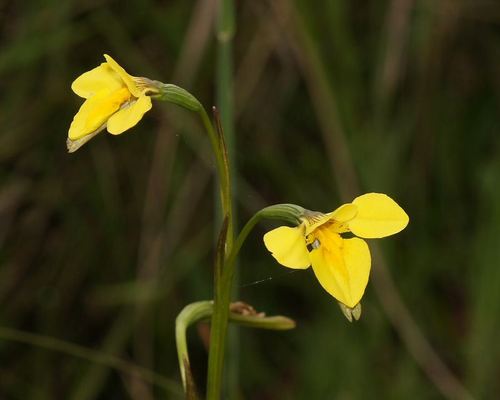
Diuris monticola is a tuberous, perennial herb. It produces between five and nine narrow linear leaves arranged in a loose tuft, with each leaf measuring 50–200 mm (2–8 in) long and 3–4 mm (0.1–0.2 in) wide. Up to four slightly drooping bright yellow flowers with dark streaks in their centre are borne on a flowering stem 150–350 mm (6–10 in) tall; each flower is 15–28 mm (0.6–1 in) wide. The dorsal sepal leans forward and is egg-shaped, 9–12 mm (0.4–0.5 in) long and 7–9 mm (0.3–0.4 in) wide. The lateral sepals are lance-shaped to egg-shaped, with the narrower end oriented toward the base, 15–25 mm (0.6–1 in) long and 2.5–4.5 mm (0.1–0.2 in) wide; they lean downwards and lie parallel to each other. The petals are egg-shaped, 7–13 mm (0.3–0.5 in) long and 4–9 mm (0.2–0.4 in) wide, and spread apart from each other on a blackish stalk 3–5.5 mm (0.1–0.2 in) long. The labellum is 12–17 mm (0.5–0.7 in) long and has three lobes. The centre lobe is egg-shaped, 7–13 mm (0.3–0.5 in) long and 6–12 mm (0.2–0.5 in) wide, while the side lobes are linear to narrowly wedge-shaped, 2–3.5 mm (0.08–0.1 in) long and 1–2 mm (0.04–0.08 in) wide with irregular edges. Two pimply, darker yellow callus ridges are found in the lower part of the labellum's mid-line. Flowering occurs from November to January. This species, commonly called highland golden moths, is widespread and common in montane grassland and snowgum woodland in the higher regions of southern New South Wales, Tasmania, the Australian Capital Territory and north-eastern Victoria.