About Diuris laxiflora Lindl.
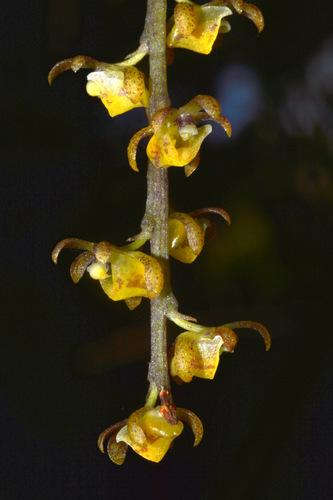
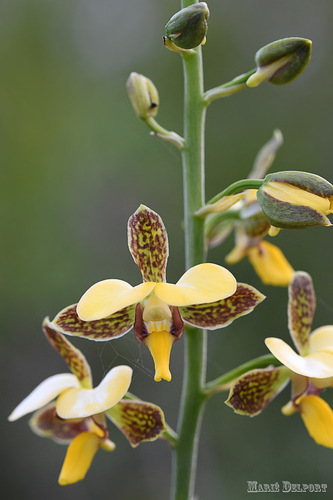
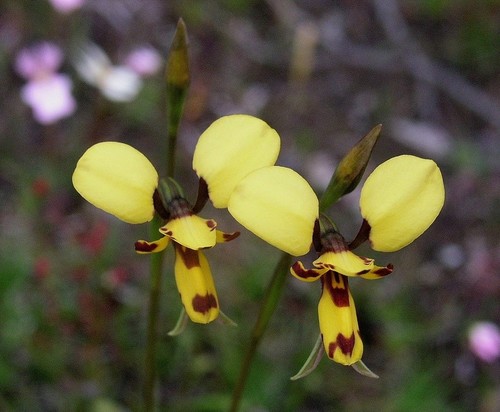
Diuris laxiflora is a tuberous perennial herb. It grows two to five narrowly linear leaves, ranging 150–300 mm (5.9–11.8 in) in length and 2.0–3.5 mm (0.079–0.138 in) in width. Between one and five yellow flowers with brown markings are carried on a 300–800 mm (12–31 in) tall flowering stem. Individual flowers measure 25–35 mm (0.98–1.38 in) long and 20–25 mm (0.79–0.98 in) wide. The dorsal sepal of the flower is narrowly egg-shaped, 7–13 mm (0.28–0.51 in) long and 5.5–8 mm (0.22–0.31 in) wide. The lateral sepals are 10–14 mm (0.39–0.55 in) long and 2.0–3.5 mm (0.079–0.138 in) wide, positioned either parallel or crossed. The petals are elliptic, egg-shaped, or almost round, 7–12 mm (0.28–0.47 in) long and 6–10 mm (0.24–0.39 in) wide, and grow from a stalk 3–5 mm (0.12–0.20 in) long. The labellum is 8–12 mm (0.31–0.47 in) long and divided into three lobes. The center lobe is broadly wedge-shaped, 7–11 mm (0.28–0.43 in) long and 8–12 mm (0.31–0.47 in) wide. The side lobes are oblong, spread widely apart, and measure 4–7 mm (0.16–0.28 in) long by 2–3 mm (0.079–0.118 in) wide, with a prominent red blotch at their base. Two red-outlined calli grow one on each side of the labellum's mid-line. The species flowers from September to early November. Diuris laxiflora is commonly known as bee orchid. It is endemic to the southwestern corner of Western Australia, found in the Avon Wheatbelt, Esperance, Geraldton Sandplains, Jarrah Forest, Mallee, Swan Coastal Plain and Warren biogeographical regions. It grows in sand, lateritic loam, and clay, as well as on granite rock margins, in winter-wet swamps.