About Diuris brumalis D.L.Jones
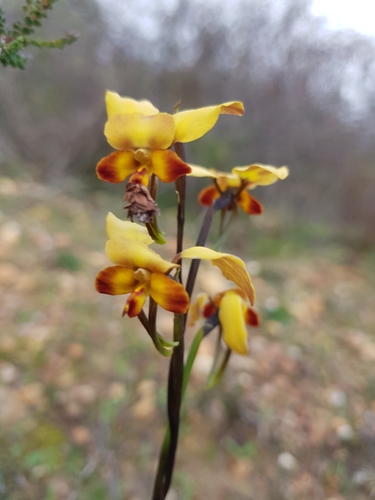
Diuris brumalis is a perennial herb that grows from a tuber, typically reaching a height of 200–500 mm (8–20 in). Two or three leaves grow at the base of the flowering stem; each leaf is 150–200 mm (6–8 in) long and 8–10 mm (0.3–0.4 in) wide. Between three and fifteen yellow and brown flowers are produced on the flowering stem. Each individual flower is 20–40 mm (0.8–2 in) long and 20–30 mm (0.8–1 in) wide. The dorsal sepal grows upright, and measures 6–12 mm (0.2–0.5 in) long by 7–15 mm (0.3–0.6 in) wide. The greenish lateral sepals are 12–24 mm (0.5–0.9 in) long, about 2 mm (0.08 in) wide, and curve downwards. The ear-shaped petals are upright, each consisting of a 2–6 mm (0.08–0.2 in) long stalk and a 10–18 mm (0.4–0.7 in) long by 6–12 mm (0.2–0.5 in) wide blade. The labellum has three lobes: the lateral lobes are 6–10 mm (0.2–0.4 in) long and 3–6 mm (0.1–0.2 in) wide. The middle lobe is wedge-shaped, 5–9 mm (0.2–0.4 in) long and 3–7 mm (0.1–0.3 in) wide. A single yellow ridge, 3–4 mm (0.1–0.2 in) in length, runs along the mid-line of the labellum. Flowering of this species occurs from June to August. This species, commonly called the winter donkey orchid, grows in shrubland and forest. It occurs between Jurien Bay and Collie, in the Avon Wheatbelt, Jarrah Forest and Swan Coastal Plain biogeographical regions of Western Australia. The flowers of this orchid look similar to the flowers of some Oxylobium and Daviesia species. They are visited by the same native bees that pollinate those species, even though this orchid does not provide visiting insects with any reward of nectar or pollen.