About Diuris aurea Sm.
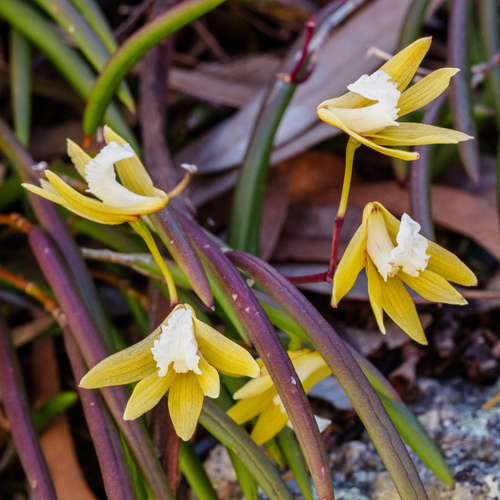
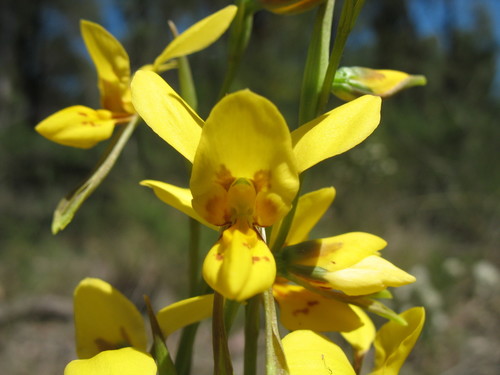
Diuris aurea Sm. is a tuberous, perennial, terrestrial herb that usually grows 30 to 60 cm (10 to 20 in) tall. It produces one or two linear leaves, each 10 to 20 cm (4 to 8 in) long, 4 to 6 mm (0.16 to 0.24 in) wide, and channelled. Between 2 and 5 golden yellow to orange flowers grow on each plant, with darker markings on the labellum and dorsal sepal. Each flower is about 3.5 cm (1 in) wide. The dorsal sepal is broad egg-shaped, 8 to 15 mm (0.3 to 0.6 in) long, 7 to 14 mm (0.3 to 0.6 in) wide, and held erect. The lateral sepals are linear to spoon-shaped, 10 to 25 mm (0.4 to 1 in) long, 2 to 5 mm (0.08 to 0.2 in) wide, and hang below the flower, usually parallel to one another. The petals are erect and spreading, forming ear-like shapes above the flower. They are broadly egg-shaped, 7 to 17 mm (0.3 to 0.7 in) long and 6 to 14 mm (0.2 to 0.6 in) wide, attached to a dark-colored, stalk-like claw that is 5 to 8 mm (0.2 to 0.3 in) long. The labellum is 10 to 16 mm (0.4 to 0.6 in) long and divided into three lobes. The lateral lobes are narrow elliptic to wedge-shaped, 4 to 6 mm (0.2 to 0.2 in) long, 2 to 4 mm (0.08 to 0.2 in) wide, with a few small teeth along their edges. The medial lobe is 7 to 13 mm (0.3 to 0.5 in) wide, with a ridge running along its center line, and a two-part callus 6 to 7 mm (0.2 to 0.3 in) long. Flowering occurs from August to November. In terms of distribution and habitat, in New South Wales this orchid, commonly called the golden donkey orchid, grows between Marulan and the Hunter Valley, in heathy and shrubby woodland, and in grassy areas within forest near the coast. It also occurs in Queensland, where it has a conservation status of 'of least concern'.