About Diuris abbreviata F.Muell. ex Benth.
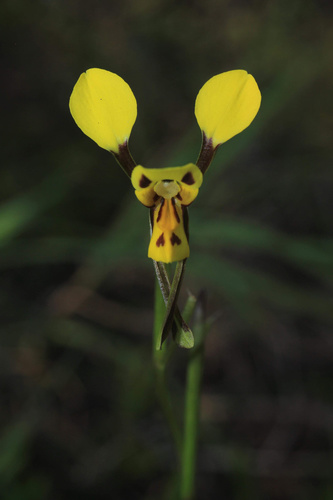
Diuris abbreviata, commonly called lemon doubletail, is a tuberous perennial herb. It grows two or three linear leaves, each between 120 and 250 mm (5 to 10 in) long, 3 to 4 mm (0.1 to 0.2 in) wide, and folded in half lengthwise. This species produces between three and nine pale to bright yellow flowers with darker markings; the flowers lean forward and measure about 25 mm (1 in) wide. The dorsal sepal is egg-shaped, 7–12 mm (0.3–0.5 in) long, 5–8 mm (0.2–0.3 in) wide, and held more or less upright. The lateral sepals are linear to lance-shaped, 11–16 mm (0.4–0.6 in) long, 1–3 mm (0.04–0.1 in) wide, and curve downwards. The petals are erect and ear-like, positioned above the flower; they are 7–14 mm (0.3–0.6 in) long and 4.5–9 mm (0.2–0.4 in) wide, attached to a brownish, stalk-like claw 3–6 mm (0.1–0.2 in) long. The labellum is 7–14 mm (0.3–0.6 in) long and divided into three lobes. The central lobe is broadly egg-shaped, around 8 mm (0.3 in) wide, with a ridge running along its midline. The lateral lobes are narrow, ranging from linear to triangular in shape, 2–4 mm (0.08–0.2 in) long and 1–1.5 mm (0.04–0.06 in) wide. Two ridge-like calli, around 5 mm (0.2 in) long, sit near the midline of the labellum. Flowering takes place from September to November. The lemon doubletail grows in forest and grassland habitats, found across the ranges and tablelands of New South Wales from north of Barrington Tops to south-east Queensland.