About Distimake aegyptius (L.) A.R.Simões & Staples
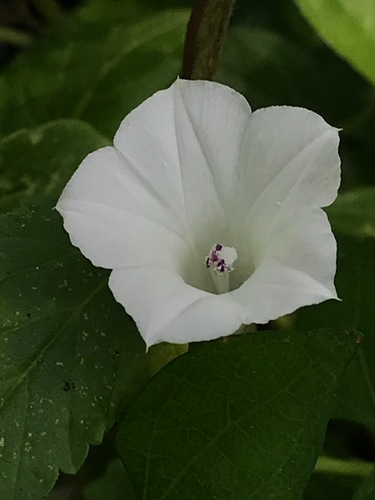
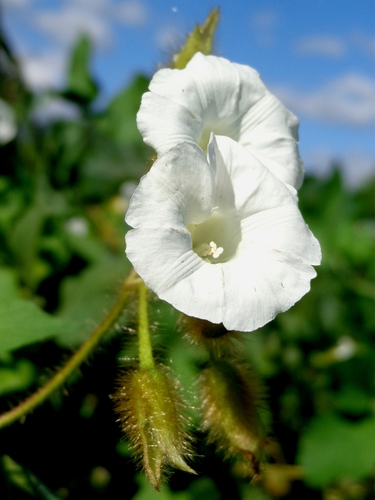
Distimake aegyptius (L.) A.R.Simões & Staples, commonly called Egyptian Woodrose, can be easily distinguished from many other morning glory species in the field by the conspicuously long, yellowish, stiff hairs that cover its stems. It has compound leaves, made up of 3 to 7 leaflets that radiate outward from a single point at the top of the petiole. Hairs on both sides of the leaflets lie close to the leaf surface. Leaflets can grow up to 9 cm (about 3½ inches) long and 5 cm (about 2 inches) wide; their margins may have low teeth, or be completely smooth. Inflorescences typically hold only two or three flowers, borne on hairy peduncles that can reach up to 20 cm (about 8 inches) long. The flowers have two distinct types of sepals: the sepals closest to the corolla are shorter, hairless or only sparsely hairy, with rounded tips, while the outer sepals are longer and sharp-pointed, covered in stiff hairs, and their surfaces may be dotted with small, nipple-shaped or rounded projections called papillae. Corollas are white, bell-shaped, hairless, and grow up to 3 cm (about 1 inch) long. Its fruits are hairless, capsule-type structures that are roughly spherical, sometimes slightly quadrangular. These capsules usually produce one to four, and can produce up to six, relatively large black hairless seeds that are slightly triangular in cross section. An iNaturalist observation map for the previously synonymized name Merremia aegyptia shows that this species grows nearly across all of the world's tropical regions, with the exception of drier areas and high elevation sites; notably, it does not occur in Egypt despite its common and scientific name. Distimake aegyptius grows in disturbed, human-altered (anthropized) environments. This species is cultivated as an ornamental plant, and its stems can be used to tie objects together. Some types of livestock will graze on this plant, but horses do not eat it. If small livestock consume large quantities of Distimake aegyptius, they develop diarrhea. In Nigeria, the dried leaves of this plant are used as a dressing for burn wounds. A 2024 study analyzing bioactive compounds in the stems and seeds of Distimake aegyptius found phytosterol compounds that are known to have antioxidant, anti-cancer, anti-inflammatory, anti-hypercholesterolemic and antidiabetic properties, making the species worthy of further research.